
Daylight Saving Time: Let the Sleeping Giant Sleep?

The big picture: more than just clocks
Twice a year, most Americans change their clocks. On the surface it seems easy to stop: pick a permanent clock time, amend the law, and let the clocks run. Yet the visible clock is only the interface to an immense ecosystem of software, regulations, transportation schedules, business contracts, healthcare records, and international coordination.
For decades, many operational systems have already anticipated the current American DST rules. Continued operation generally does not require the extraordinary migration that a new permanent rule might. That does not mean the current system is cost-free; it means the baseline and the proposed change need to be compared honestly.
The central question is not whether permanent time is technically possible. It is how to change a mature network of dependencies without introducing avoidable operational failures, and whether the benefits justify the costs. This article separates documented facts, credible engineering risk, and illustrative economic scenarios.
Clocks change. The flow of time does not. Daylight Saving Time changes our civil representation of time, not the sequence of events in the universe.
What would actually change?
Under current U.S. rules, DST begins on the second Sunday in March and ends on the first Sunday in November in participating jurisdictions. NIST identifies March 8 through November 1 as the 2026 interval. Some jurisdictions do not observe DST. Federal legislation and jurisdictional differences matter: permanent standard time and permanent daylight time have different legal routes and different real-world sunlight consequences. [1] [2]
There are three distinct policy paths: retain the present seasonal rules; permanently use standard time; or permanently use the summer daylight offset. Neither permanent option changes the duration of a second or the UTC timescale. It changes the legal mapping from an instant to a local clock reading. The details of that mapping are embedded across systems.
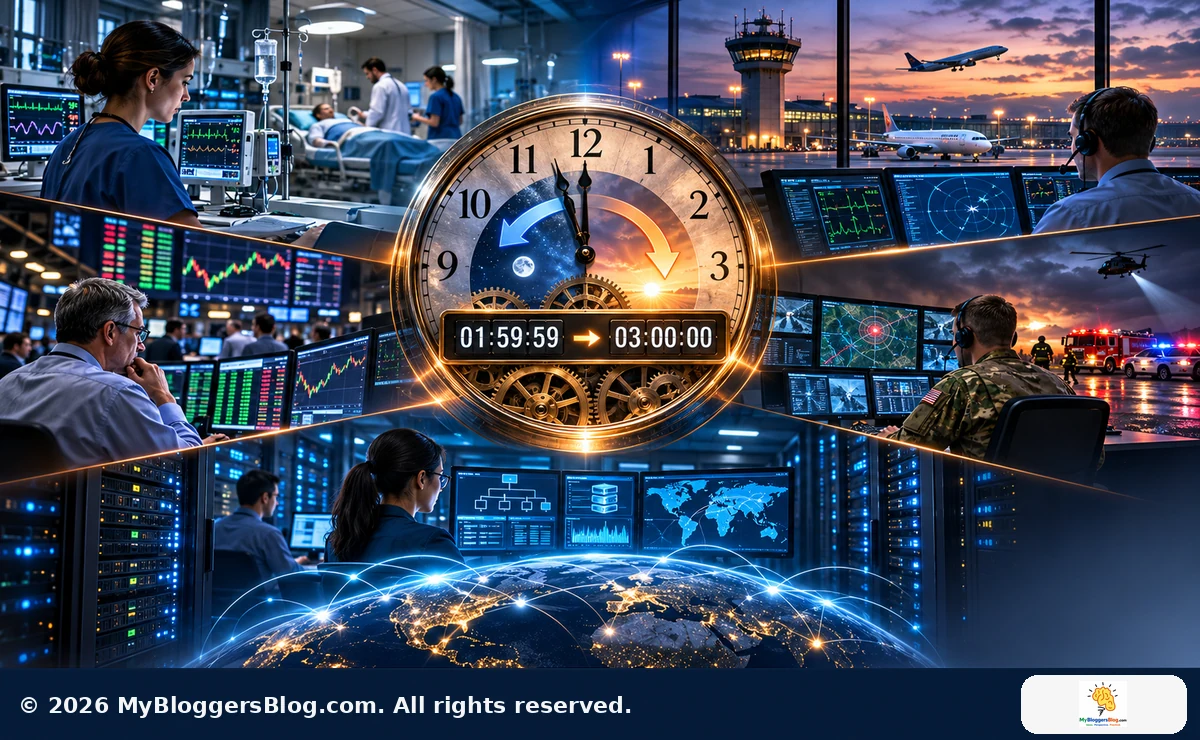
At the 2026 fall transition in Eastern Time, 1:30 a.m. EDT and 1:30 a.m. EST are an hour apart. Recording just “1:30 a.m.” loses information. The remedy is an unambiguous instant, such as UTC, with the local zone and offset retained when necessary.
The hidden danger: decades of hard-coded assumptions
A programmer may have typed a fixed UTC offset, a March or November date rule, or an assumption that every calendar day always contains exactly 24 local-clock hours. Those assumptions may be copied, buried in stored procedures, compiled into binaries, supplied by a vendor, or placed inside embedded firmware with no supported update mechanism.
AI-powered code search can assist inventory work but cannot certify that every time-dependent condition has been found. A search for “DST” will not reveal every expression such as timestamp - 5 * 3600, and not every appearance of the number five represents a timezone. Black-box behavior, obsolete source code, equipment that cannot be patched, and contracts with third parties create additional blind spots.
One failure may occur immediately at the effective date. Another could remain dormant until a rare annual report, an archived-data restoration, a cross-border business event, or an unusual scheduling interval activates it years later. That is why testing must include historical dates, future dates, international partners, exception paths, and long-term monitoring—not merely changing a date in a configuration file.
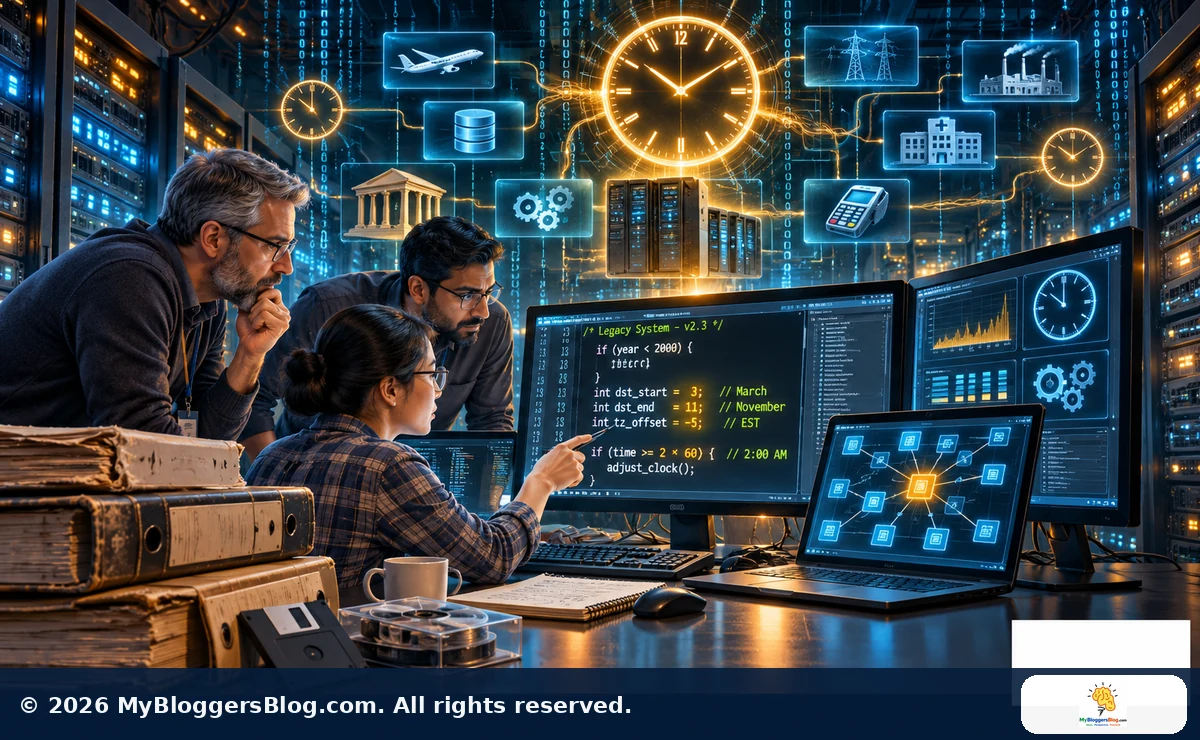
Maintained operating systems and IANA time-zone data make many ordinary updates manageable. The burden is concentrated in custom, legacy and deeply integrated applications. [6] [7]
The critical sectors: aviation, military, GPS, banking and healthcare
Aviation: Pilots and aviation infrastructure extensively use UTC, but airlines and airports also publish local schedules. Crew assignments, maintenance, reservations, international connections, codeshare arrangements and passenger communications depend on consistent conversion. A policy change need not disturb an aircraft’s UTC clock to create a scheduling dispute.
Military and GPS: Satellite timing is not governed by DST, and GPS satellites would not be retimed simply because Congress changes civil-time law. Operational planning tools, receivers displaying local time, logistics, contractor networks and mission interfaces using local civil time still need review. The risk is inconsistent interpretation, not a spontaneous change to the satellite timescale.
Banking and markets: Settlement windows, batch processing, regulatory reporting, cutoffs, cross-market overlaps and fraud monitoring need explicit interpretation. The Federal Reserve operates complex time-sensitive services; financial platforms use testing and operational controls to coordinate changes. [8]
Healthcare: Electronic health records, medication administration, infusion pumps, monitoring systems and overnight staffing schedules need accurate elapsed durations and event chronology. An unqualified repeated local timestamp could make one medication event appear simultaneous with another. This is a plausible failure mode, not a claim of a known defect in a specific vendor. Peer-reviewed observational research has associated DST transitions with healthcare safety incidents. [11]
Emergency services: 911 and CAD dispatch, radio recordings, body cameras, evidence management, and law-enforcement RMS systems need reconstructable timelines. An officer’s arrival after a backward clock change must not appear to precede the dispatch call.
Energy and industrial systems: Metering intervals, utility billing, controllers, SCADA, overnight shifts and scheduled maintenance could require special handling. These are different risks from those of everyday alarm clocks.
The international ripple effect
A change made in the United States does not stop at its borders. It affects businesses and organizations elsewhere that use American Eastern, Central, Mountain or Pacific civil-time rules in schedules and contracts. Consider an Indian service desk supporting a U.S. hospital, a European financial desk aligned with a New York trading session, or an overseas airline partner coordinating a connecting flight.

Time-zone database updates may propagate rapidly, while bespoke business workflows may not. Different suppliers may update on different dates; some countries continue their own seasonal time changes on separate calendars. International cost models must therefore include overseas suppliers, subsidiaries and partners, not just U.S. employers.
None of this means every overseas company must rebuild its systems. UTC-based contracts, explicit IANA zone identifiers and versioned rules substantially reduce exposure. What matters is the number of actual dependencies and their complexity.
Could implementing the change cost billions?
Yes, costs in the billions cannot be excluded; no authoritative nationwide total is established. A careful answer needs an inventory of affected organizations, average remediation effort, hardware replacement needs, testing and certification, international coordination, and a distinction between ordinary software maintenance and incremental DST-policy costs.
For sensitivity analysis, we constructed illustrative scenarios. They are not official forecasts, probability distributions or worst-case bounds. The model adds five nonoverlapping expense categories: complex U.S. institutions, other domestic enterprises, small businesses, international partners and central coordination.

| Workstream | Lower | Central | Stress |
|---|---|---|---|
| High-complexity U.S. institutions | 0.50 | 4.50 | 24.00 |
| Other U.S. enterprises | 0.75 | 6.00 | 37.50 |
| Small businesses | 0.10 | 0.90 | 4.80 |
| International partners | 0.10 | 1.50 | 12.00 |
| Coordination/public implementation | 0.10 | 0.50 | 2.00 |
| Total | 1.55 | 13.40 | 80.30 |
Central scenario arithmetic: 1,500 complex institutions × $3 million ($4.5B); 30,000 other enterprises × $200,000 ($6B); 300,000 small businesses × $3,000 ($0.9B); 10,000 international partners × $150,000 ($1.5B); plus $0.5B coordination. These organization counts and unit costs are assumptions created to illustrate sensitivity, not verified population data.
Incident recovery, disrupted services, litigation and delayed implementation may add costs; however, merely assigning them another few billion would be unjustified. A 10–30% contingency on the central scenario would produce $14.74–$17.42B in total planned resources, but it would remain a budgeting assumption, not an estimate of actual losses. Any credible cost-benefit study also must subtract costs of recurring DST transitions avoided in future years.
Y2K: a warning about complexity, not a direct prediction
The Year 2000 problem exposed hidden two-digit-year assumptions in computers, business systems, embedded equipment and public-sector applications. Remediation required sustained testing and coordination. A GAO publication reported a May 1999 estimate of $8.7 billion for the systems of 24 major federal agencies. That was not the final worldwide price tag for Y2K. [3]

Using 1999 annual average CPI-U of 166.6 and September 2026 CPI-U of 336.940, the historical estimate becomes approximately $17.59 billion in September 2026 dollars: $8.7B × (336.940 ÷ 166.6). Inflation adjusts purchasing power; it does not transform a Y2K estimate into a DST-remediation cost estimate. [4] [5]
The analogy is useful because small date assumptions can spread through unexpected dependencies. It has limits because Y2K potentially affected fundamental date arithmetic while permanent-time reform primarily modifies the rules for converting UTC into future local civil time.
Could stock trading alone lose billions?
Modern markets transact enormous values under rigorous timestamping and sequencing requirements. A faulty calendar or local-time conversion could affect trading windows, cross-exchange handoffs, reconciliation, surveillance and regulatory reporting. The SEC’s Consolidated Audit Trail framework illustrates the importance of consistent event chronology. [9]
However, a billion dollars of trading activity affected is not the same as a billion dollars in economic losses. Loss models must consider the actual disruption duration, affected customers and orders, realized financial harm, transfers among participants, mitigation, and recovery. Billion-dollar stress scenarios are conceivable, but the available evidence does not quantify their probability or justify including them as certain costs.
Legislation, contracts and lawsuits
Transition legislation would need to specify effective dates, jurisdictional rules, treatment of historical records, filing deadlines, regulatory cutoff times and interpretation of contract references to local civil time. Regulators might need to amend rules and industry standards, while vendors and customers would need to clarify responsibilities.
Historically, Congress enacted the Y2K Act to address particular litigation issues arising from millennium-related failures. That statute is a precedent for legislative attention to systemic change risk, not a ready-made shield for a DST policy. Proposed protections could involve safe harbors for good-faith compliance, notice procedures, allocation of liability and evidence retention—balanced against rights of consumers and injured parties.
Potential lawsuits could arise from demonstrable harms, but not every later outage would be caused by the policy change. Litigation estimates should not simply presume either universal fault or universal immunity.
A transition measured in years?
A comprehensive national program might require successive phases: legislation and authoritative specifications; an inventory of dependencies and vendors; engineering and replacement; independent test cycles; staged deployment; then extended monitoring. Safety-critical and financially sensitive operators would require greater assurance than a personal wall clock.

For planning purposes, three to five years of preparation and coordinated migration, with additional overlapping monitoring over one to three years, is a reasonable conservative scenario to test. These durations are not official forecasts or universal minimums. Some systems could migrate far faster; unsupported systems could take longer. Microsoft recommends extensive advance notification for government time-zone changes. [7]
Rollback is harder than it sounds: reversing a legal time policy may not undo orders, billing records, contracts or timestamps already written under the new rule. Each critical system should have a documented response strategy, with historical data protected from reinterpretation.
From kitchen clocks to churches
A manually adjusted microwave clock, bedroom clock or analog bathroom clock that has no connection to other systems is not an interoperability problem. Its owner may no longer have to make seasonal adjustments. Unlike a networked scheduling device, it has no automated dependencies to synchronize.
Church services, classes, community meetings and events generally can be rescheduled or communicated with relatively low technical effort. Nevertheless, online calendars, reminders, livestreams and international congregations create modest coordination requirements. Scope matters: society includes everything from isolated devices to integrated, regulated systems.
Unforeseen failures and the blame problem
Good engineers plan for the faults they have not yet seen. A system may work for months before an uncommon combination of date, jurisdiction, archive restoration, cross-border schedule or vendor version triggers an error. Root-cause analysis can be expensive because a failure manifests at one interface while originating elsewhere.
The reverse problem is also possible: a failure unrelated to DST reform may be publicly attributed to it simply because the policy has changed. Maintaining change logs, time-zone database versions, observable metrics, incident reports and independent forensic records helps establish causation rather than relying on assumptions.
No realistic software transition can promise zero defects. The objective is proportionate assurance: find the high-consequence cases first, reduce their likelihood, and contain any incident promptly.
Let the sleeping giant sleep?
The existing system has decades of practical integration behind it. That is a legitimate reason to demand strong evidence before a major change. It also has recurring clock transitions, scheduling friction and some documented associations with health and safety outcomes. Familiarity does not prove optimality; novelty does not prove improvement.
The policy-priority question is not resolved by an announcement or social media post. A functioning nation has limited legislative time, engineering capacity and budget. If an expensive time-policy transition competes with other urgent needs, the tradeoffs deserve a public analysis that distinguishes cost from conjecture and human benefit from implementation burden.
Conversely, if permanent time provides significant recurring benefits, those benefits should be quantified rather than ignored. Both sides of the ledger matter.
What comprehensive technical documentation should include
An accountable transition would require a durable specification of civil-time rules, stakeholder inventory, system and integration diagrams, time-zone library versions, source-code and firmware review outcomes, vendor assurances, compatibility matrices, regression-test evidence, financial and safety impact assessments, release plans and contingency procedures.
It should specify how to preserve historical timestamps, represent ambiguous local times, handle missing spring-forward hours when applicable, interpret future contracts, verify UTC synchronization, and track exceptions. Critical services should additionally document independent validation, operational signoffs and post-cutover monitoring.
Unambiguous documentation is not paperwork for its own sake. It makes future troubleshooting, litigation defense and the maintenance of decades-old data materially easier.
Conclusion: measure first, legislate with a transition plan
A permanent-time rule is technically achievable. It is not merely a decision to stop pressing buttons on household clocks. It could entail hidden application changes, international coordination, expensive testing, difficult contracts and a long tail of legacy defects. The scale is unknown; our illustrative multibillion-dollar scenarios establish plausibility, not probability.
Before setting a binding national effective date, policymakers should commission an independent inventory and impact assessment across critical infrastructure, government, industries and overseas partners. The assessment should compare one-time remediation and incident risks with ongoing costs and benefits under the current approach, and distinguish permanent standard time from permanent daylight time.
Let the sleeping giant sleep—until there is a credible, transparent and thoroughly tested plan for waking it.
The central lesson of Y2K is not that catastrophe was inevitable; it is that invisible preparation was part of why catastrophic outcomes largely did not materialize.
Official and primary research sources
Sources were selected for government, regulatory, standards, platform or indexed peer-reviewed authority. Source dates and applicability vary; interpretations and scenarios in this article are the author’s analytical synthesis.
- National Institute of Standards and Technology (NIST): Daylight Saving Time Rules
- U.S. Department of Transportation: Uniform Time
- Government Accountability Office: 1999 Y2K Federal Cost Estimate
- Bureau of Labor Statistics: September 2026 CPI
- Bureau of Labor Statistics: Historical CPI tables
- IANA Time Zone Database
- Microsoft: Daylight Saving Time Help and Support
- Federal Reserve: Fedwire Funds Service
- Securities and Exchange Commission: Consolidated Audit Trail
- U.S. Department of Energy: Extended DST Energy Analysis
- National Library of Medicine: DST and Patient Safety study