Executive summary
A scratching sound above the ceiling creates an understandable urge to make the problem disappear immediately. But if the objective is genuinely humane, the question should not be, “How do I kill or capture whatever is up there?” The better question is, “Why can this animal enter my house, and how do I make that impossible without harming it?”
That shift changes the entire strategy. Rats and mice do not need to be poisoned, intentionally killed, glued to a surface, or carried to a distant landscape in order to remove them from a house. The durable solution is structural: determine how they are entering, allow or guide animals already inside to leave safely, make sure dependent young are not abandoned, close all usable access points with rodent-resistant construction, remove food and shelter conditions that support repeated visits, and clean contamination according to public-health guidance.
This is consistent with the prevention emphasis of the U.S. Environmental Protection Agency, which identifies preventing rodent access, maintaining cleanliness, and eliminating nesting opportunities as central measures. The Centers for Disease Control and Prevention likewise directs homeowners to inspect for gaps and holes, seal them, secure food and garbage, and reduce outdoor conditions that support rodents. The National Park Service has gone even further in its technical rodent-exclusion manual, treating exclusion as a building-maintenance discipline that depends on detailed inspection, durable materials, sanitation, monitoring, and repeated verification.
The approach is particularly suitable for attics, wall spaces, crawl spaces, garages, utility areas, sheds, and other parts of a structure where rats or mice have found a protected route. It also provides a useful philosophy for other wildlife conflicts, although species-specific laws, breeding seasons, health risks, and exclusion rules must always be checked before applying the same technique to bats, squirrels, raccoons, birds, or other animals.
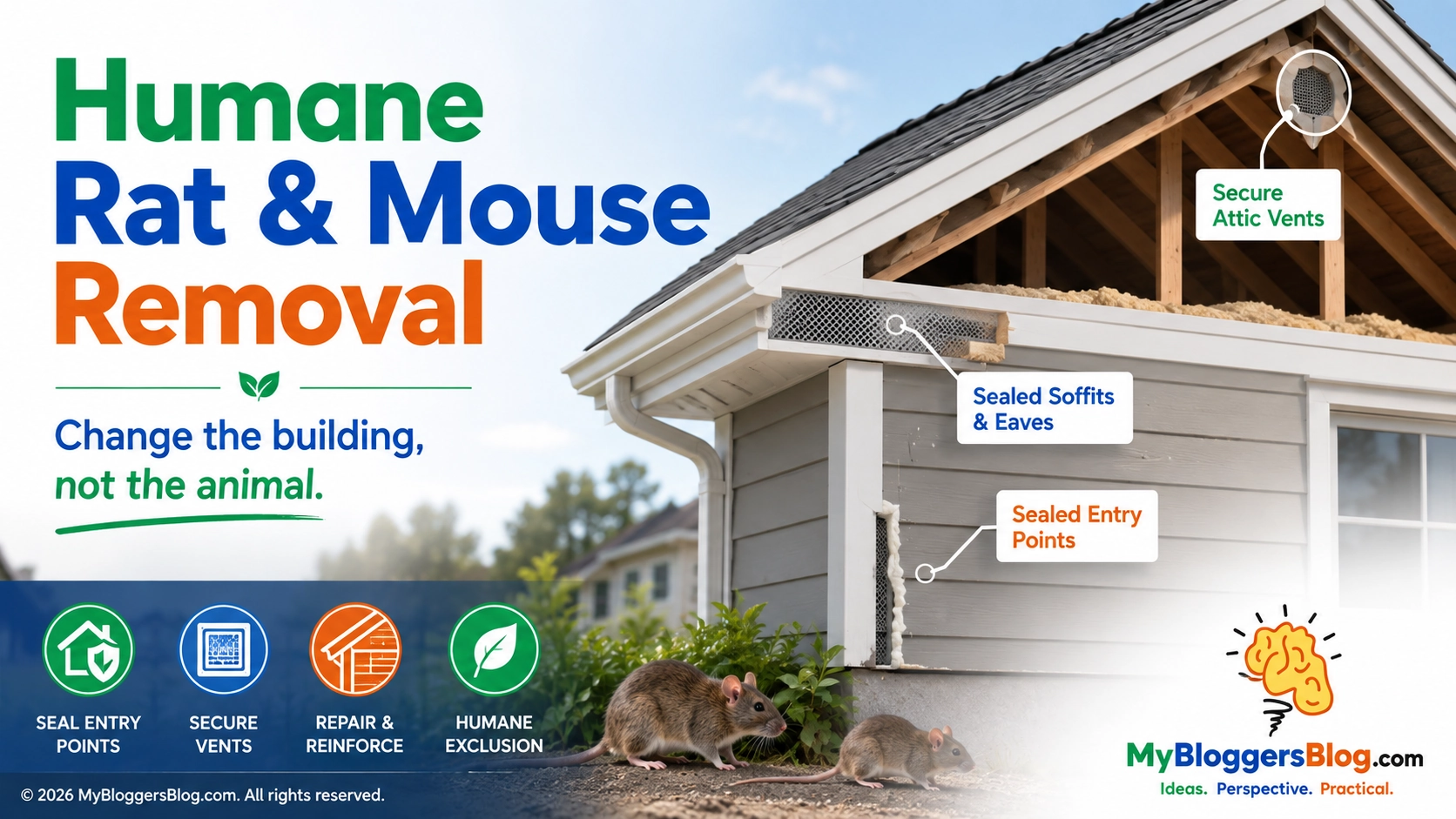
The real solution is to change the building
A rodent inside an attic is evidence of a building-envelope failure. Somewhere between the outdoors and the nesting space, the animal found a route that the building allowed it to use. It may be a damaged soffit, an unscreened vent, a gap at a roof intersection, a utility penetration, loose flashing, a door gap, a hole near a foundation, or a combination of small openings connected through wall and ceiling voids.
That matters because removing an individual animal without correcting the access route leaves the essential problem untouched. New Jersey Fish & Wildlife makes this broader point in its wildlife-relocation policy: when nuisance wildlife is involved, habitat alteration and exclusion should be used when possible, and failing to correct the attractant or use exclusionary devices means the problem is likely to continue even when an animal is removed.
For a homeowner, this turns rodent control into a form of building science. The house has to be examined from the foundation to the roof. The objective is not merely to make the attic unpleasant for tonight. The objective is to remove the pathways that make the attic available at all.
The National Park Service summarizes the exclusion concept with a remarkably simple idea: if animals are kept out, they cannot get in. Its manual emphasizes inspection of both building defects and human practices that provide food, water, shelter, or routes of entry. This is the foundation of a humane strategy because it solves the conflict without requiring the animal to be poisoned or killed.
Why attics work so well for rats and mice
An attic can be an unusually effective shelter. It is protected from rain, wind, predators, and temperature extremes. It may contain insulation and stored material suitable for nesting. It is often quiet for most of the day. Wall cavities, chases, plumbing routes, duct spaces, and roof framing can connect it to other parts of the structure. Food does not have to be in the attic itself; an animal can nest above and forage elsewhere.
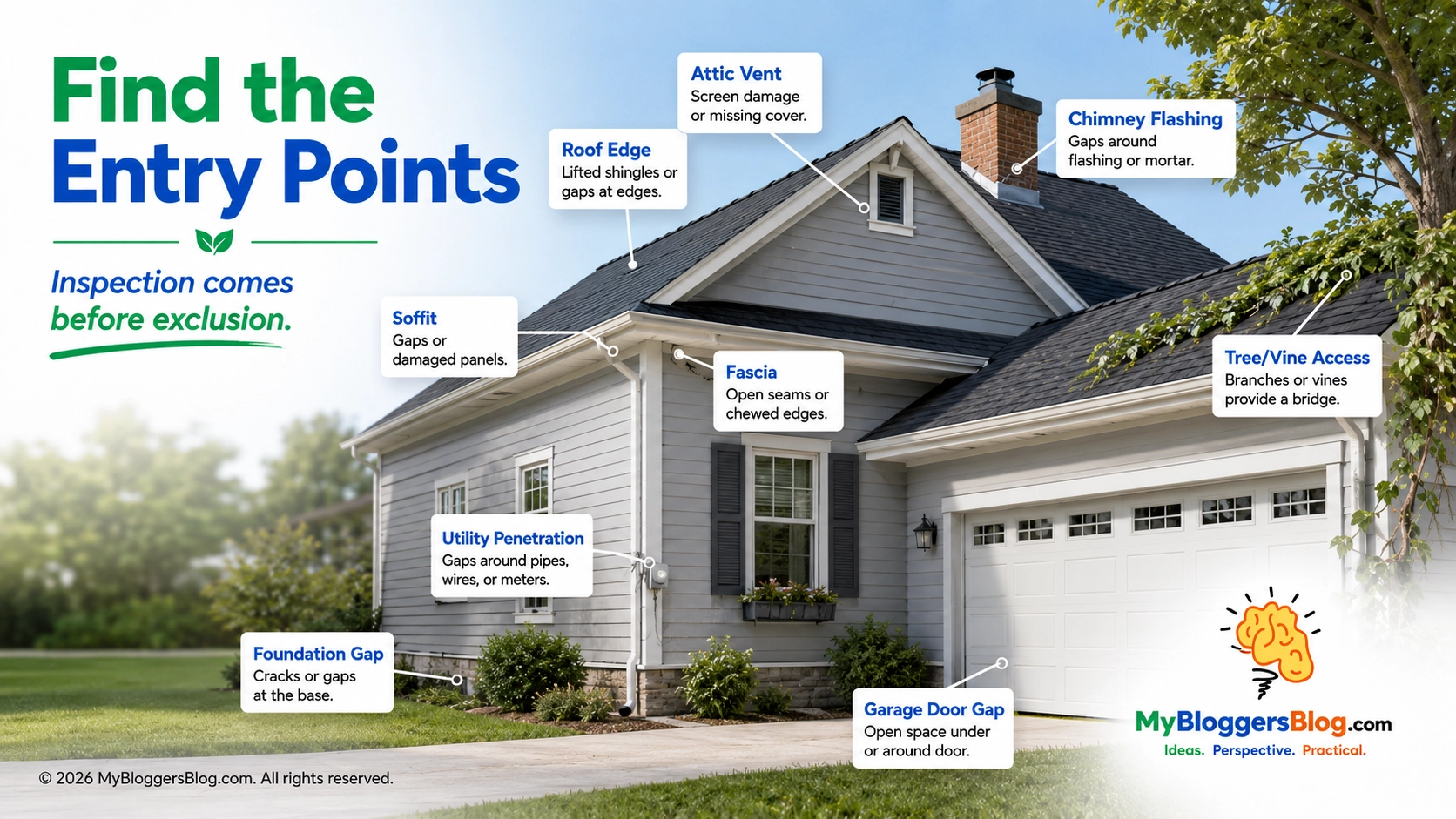
Small openings are enough. CDC states that a mouse can fit through a hole about the width of a pencil, approximately one-quarter inch or 6 millimeters. Its homeowner guidance specifically tells people to inspect attics and to examine rafters, gables, eaves, soffits, attic vents, and openings around electrical, plumbing, cable, and gas lines.
The National Park Service uses the same one-quarter-inch threshold throughout its exclusion manual. It instructs inspectors to look for openings of that size or larger and identifies roof defects, utility penetrations, vents, door gaps, siding joints, foundations, vegetation, and internal wall or ceiling voids as potential pathways.
This is why a casual exterior walk-around can miss the real problem. A house may look completely intact from ground level while a narrow construction gap, deteriorated vent screen, or hidden utility opening provides a route directly into the attic.
Start with inspection, not treatment
A humane exclusion job should begin with evidence. Before anything is sealed, the homeowner or professional needs to understand where activity is occurring and how the animal is moving through the structure.
Useful signs include droppings, gnawing, nesting material, disturbed insulation, rub or smudge marks along repeated travel routes, tracks, sounds, and damage around openings. EPA lists droppings, nesting material, gnawed food packaging, holes, and stale odors among common signs of rodent activity. The National Park Service adds runways, burrows, structural gnawing, rub marks, damaged vegetation, and harborage to the inspection picture.
The inspection should cover both sides of the building envelope. From outside, examine the foundation, siding, door thresholds, roof edges, eaves, soffits, gables, dormer intersections, chimney flashing, vents, utility lines, cable penetrations, plumbing penetrations, roof-mounted equipment, and the places where additions or porches meet the original building. From inside, inspect the attic perimeter, wall and ceiling penetrations, service chases, pipe openings, duct routes, storage areas, and locations showing concentrated rodent evidence.
One practical technique appears in official wildlife guidance from Maine: when inspecting an attic or other enclosed space during daylight, turning off the light may reveal daylight coming through hidden holes or gaps. Those locations can then be marked for exterior examination. Daylight is not proof that a rodent is using an opening, but it is a strong clue that the building envelope deserves closer inspection.
Inspection should answer four different questions:
- Where can a rodent enter? Every opening that is physically large enough or can be enlarged by gnawing.
- Which opening appears active? The route supported by fresh evidence, tracks, staining, gnawing, or direct observation.
- Where is the animal living or traveling inside? Attic edges, insulation, wall voids, chases, utility areas, or other connected spaces.
- What conditions are supporting the activity? Food, water, garbage, bird seed, pet food, vegetation, clutter, or easily accessible shelter.
That distinction is critical. Potential openings need repair, but an active opening may need to remain temporarily available as part of the humane exit plan.
Build an exclusion map of the house
For anything more than a very simple case, it helps to treat the inspection as a map rather than a list. Photograph the exterior elevations. Number the suspected openings. Record their approximate size, location, condition, and evidence of activity. Note whether each opening can be closed immediately or must remain part of the controlled exit process.
| Location | What to document | Humane exclusion question |
|---|---|---|
| Roof, eaves and soffits | Loose material, gaps, damaged fascia, roof intersections, gnawing, staining | Is this only a defect, or is it an active route? |
| Attic and crawl-space vents | Screen condition, mesh size, loose edges, missing covers | Can ventilation remain functional while the opening becomes rodent resistant? |
| Chimneys and vent pipes | Flashing, caps, surrounding gaps, roof penetration | What repair preserves fire and ventilation safety? |
| Utility entries | Electrical, cable, gas, water, HVAC and plumbing penetrations | Can the gap be closed with durable, service-compatible materials? |
| Foundation and lower walls | Cracks, siding gaps, door sweeps, garage edges, burrows | Are rodents entering low and then traveling upward inside walls? |
| Vegetation | Branches, vines, dense shrubs, stored material near walls | Does the landscape provide a climbing route or protected approach? |
This documentation becomes especially valuable when a professional is involved. It allows the homeowner to ask whether the proposal addresses the entire structure or only the most obvious hole. Humane exclusion fails when an animal is blocked from one opening but simply finds another defect a few feet away.
Humane eviction is a sequence
The order of work matters. If animals are still inside, immediately sealing every opening can create a new welfare and building problem. A trapped animal may search aggressively for another exit, enter occupied areas, damage materials, or leave dependent young behind. The humane objective is therefore not “seal everything immediately.” It is “control the exits, verify departure, then finish the building.”
Official wildlife guidance from Maine describes this sequencing clearly for animals occupying structures: determine the active opening, determine whether young are involved, close alternative access points as appropriate, verify that the animal has gone, and then seal the remaining entry. New Jersey's wildlife policy likewise emphasizes exclusion and habitat correction rather than merely moving the animal elsewhere.
For rats and mice, the exact field technique will depend on the species, the number of openings, the construction of the house, and whether a true active route can be isolated. Mice in particular can exploit extremely small gaps, so a one-way device at one visible hole is not a substitute for a whole-building inspection.
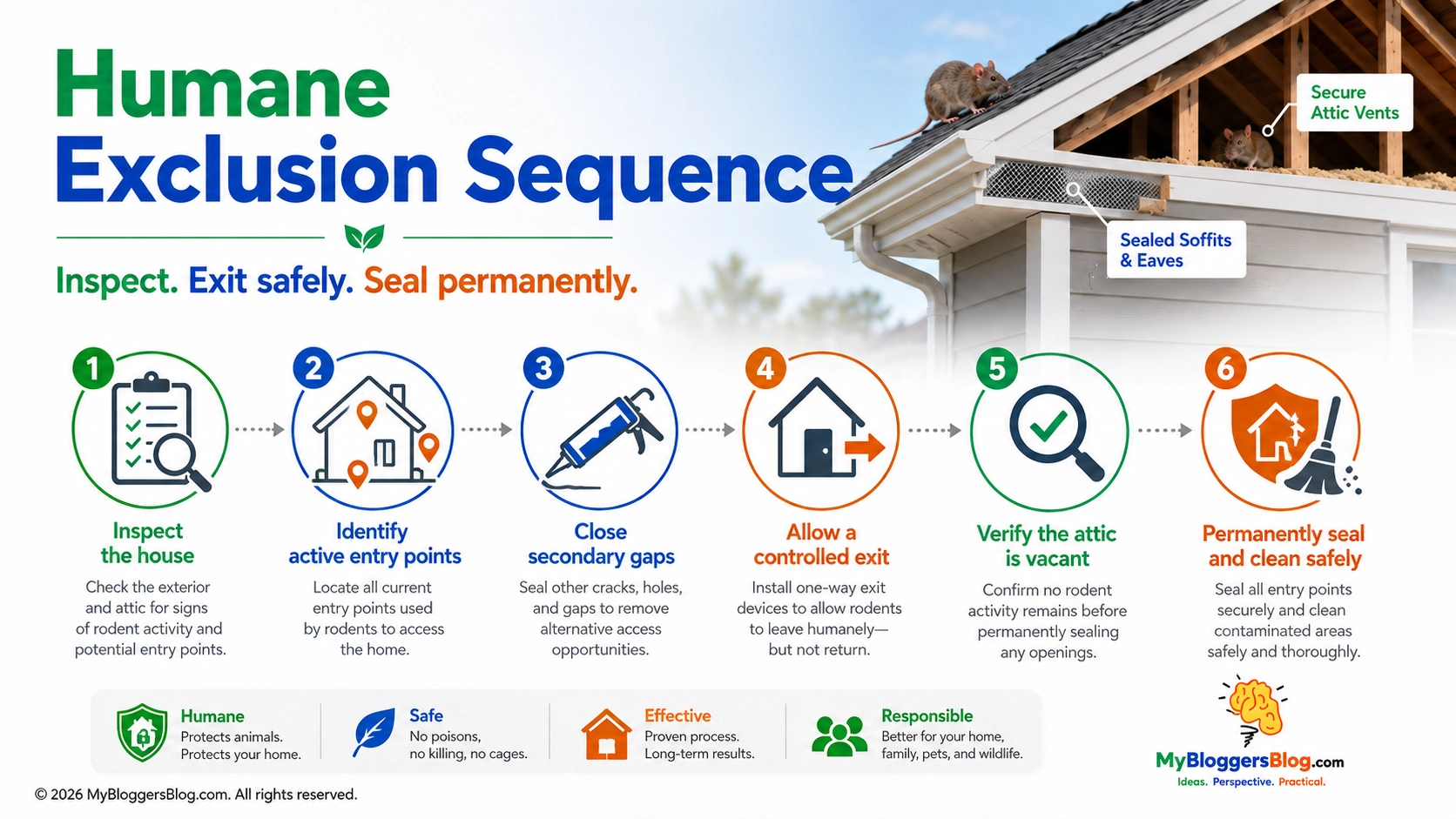
A well-managed humane sequence generally looks like this:
- Confirm rodent activity and likely species. Avoid assuming every attic sound is a rat or mouse.
- Inspect the complete structure. Identify active and potential access points.
- Check for dependent young and nesting areas. Do not create an exclusion plan that abandons them.
- Close secondary inactive openings. Reduce the number of possible return paths with durable repairs.
- Maintain or create a controlled exit at the active route. Where appropriate, use a species- and structure-appropriate one-way exclusion device.
- Monitor the exit and indoor activity. Do not declare success based on one quiet night.
- Verify that animals have left. Use observation, tracking indicators, absence of fresh signs, and professional judgment.
- Remove the temporary exclusion device and permanently repair the last opening.
- Clean contamination safely. Follow public-health guidance rather than dry sweeping or vacuuming.
- Reinspect the building. Weather, settlement, construction, and maintenance can create new gaps over time.
One-way exclusion: exit without re-entry
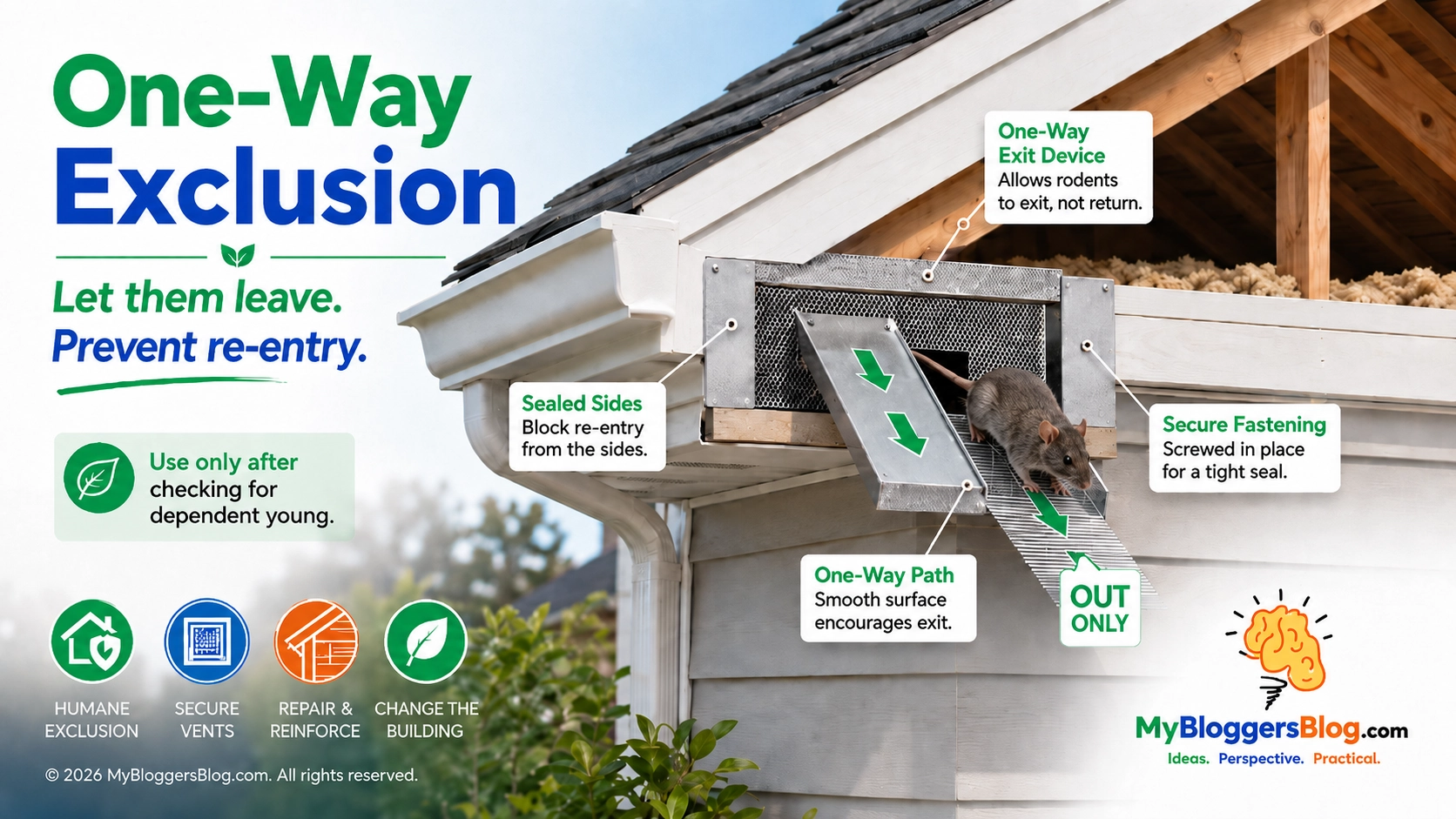
A one-way exclusion device is conceptually simple: an active opening is fitted so that an animal can leave but cannot use the same route to return. Once the structure is confirmed vacant, the temporary device is removed and the opening is permanently repaired.
Maine's Department of Inland Fisheries and Wildlife describes one-way doors as a tool for evicting animals from buildings and stresses two conditions that matter to humane work: the device must be installed correctly, and it should be used only when the operator is sure that young will not be trapped inside. The agency also recommends verifying success before removing the device and sealing the exit.
For attic rats and mice, the concept requires professional judgment. A building may have multiple entry points. An opening may be irregular or hidden behind trim. A mouse may be using a route too small or complicated for a conventional wildlife door. A roof rat may have several elevated paths. A device that is poorly attached can create another gap. A device placed on the wrong opening accomplishes nothing.
That is why “install a one-way door” should never be treated as a stand-alone recipe. It is one component of a larger exclusion system. The rest of the structure must be secured sufficiently that leaving animals cannot simply circle the building and re-enter through another defect.
Monitoring matters after installation. Maine wildlife guidance describes several verification approaches, including visual observation and tracking signs outside the exit. The broader principle is more important than any one technique: do not convert a temporary exit into a permanent seal until there is reasonable evidence that the occupied space is vacant.
Do not separate adults from dependent young
This is one of the most important differences between ordinary hole sealing and genuinely humane exclusion.
Maine's official wildlife guidance says to determine whether young animals are involved before proceeding and specifically warns that failing to do so can separate a female from her young. It advises checking even when the time of year seems too early or too late. New Jersey Fish & Wildlife similarly requires attention to newborns when adult nuisance wildlife is being relocated and emphasizes keeping young with adults.
For a humane homeowner or contractor, the operating rule should be broader than any calendar: if nesting is suspected, investigate before closing the route. Sounds from a concentrated location, nesting material, repeated adult movement, or evidence around insulation may justify a more careful inspection.
If dependent young are present and cannot leave on their own, the preferred outcome is to keep the family unit together and avoid abandonment. The exact response depends on species, accessibility, building conditions, and local law. When there is uncertainty, a wildlife professional or licensed rehabilitator should be consulted rather than improvising.
This is also why an exclusion contractor should be able to answer a specific question before work begins: How will you determine whether dependent young are present, and what will you do if you find them?
Permanent rodent-proof construction
Once animals are out, the success of the entire project depends on the quality of the repair. The finished building must resist weather, movement, routine maintenance, and gnawing. A cosmetic patch that looks closed from a distance is not necessarily rodent proof.
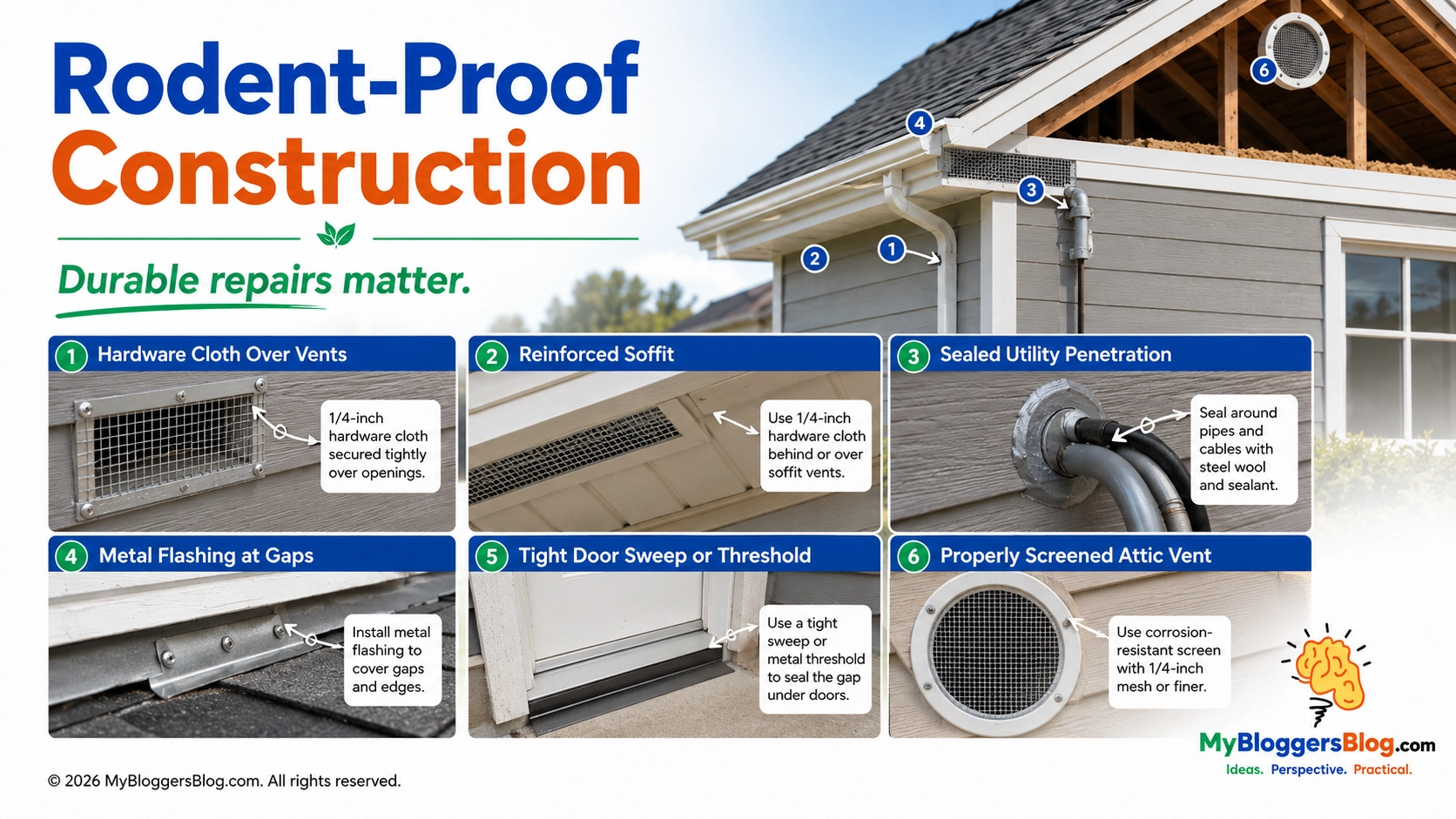
CDC recommends steel wool secured with caulk for small holes and materials such as metal, cement, lath screen, hardware cloth, or metal sheeting for larger openings. The National Park Service provides more detailed construction guidance. Its rodent-exclusion manual repeatedly uses one-quarter-inch openings as a critical threshold, recommends one-quarter-inch hardware cloth for mouse exclusion, and identifies galvanized sheet metal as an appropriate durable exclusion material for many applications.
The NPS manual also warns indirectly against a common mistake: an opening filled only partially with expanding foam can still remain usable. In illustrated examples, the agency combines filler or foam with copper mesh or hardware cloth where appropriate. The important lesson is not that one product is universally correct. It is that the repair must become mechanically resistant to rodent entry, not merely visually filled.
| Building condition | Exclusion objective | Common durable approaches identified by official guidance |
|---|---|---|
| Small irregular gap | Eliminate the opening and resist reopening | Steel or copper-type mesh combined with suitable sealant where appropriate |
| Larger hole | Create a gnaw-resistant physical barrier | Hardware cloth, metal sheeting, lath screen, cement or other building-compatible repair |
| Attic or crawl-space vent | Preserve ventilation while blocking rodent access | Properly secured rodent-resistant screen or screened vent |
| Door or threshold | Remove usable clearance | Weather stripping, tight threshold, door sweep, metal reinforcement where needed |
| Utility penetration | Close the annular gap without interfering with service | Appropriate sealant plus rodent-resistant filler or metal barrier as conditions require |
| Roof penetration | Close gaps while preserving drainage, flashing and equipment function | Professional flashing repair, screening, metal detailing, or roof-compatible construction |
There is also a maintenance reality. The National Park Service notes that exclusion is not permanent in the sense of “repair it once and never inspect again.” Weather, building settlement, renovations, utility work, wear, and site use can create new defects. Humane exclusion is therefore best understood as an ongoing property-maintenance standard.
Roofs, soffits, vents, chimneys and utilities
Attic exclusion deserves special care because many roof openings serve legitimate purposes. A vent must ventilate. A dryer exhaust must exhaust. A chimney must operate safely. Plumbing and HVAC penetrations must remain serviceable. The correct answer is therefore not “seal every opening solid.” It is “make every required opening function correctly while preventing rodent access.”
The National Park Service directs inspectors to examine roofs, chimneys, vent pipes, flashing, HVAC penetrations, utility lines, eaves, soffits, gables, and roof materials. It recommends rodent-resistant screening where safe and appropriate, and specifically identifies one-quarter-inch mesh hardware cloth for many attic and crawl-space vent applications.
Some work should not be improvised. Combustion vents, chimneys, dryer exhausts, roof drainage details, and certain HVAC components can create fire, moisture, carbon-monoxide, or equipment risks if altered incorrectly. A humane rodent repair that creates a building-safety problem is not a successful repair. When the opening is part of a regulated mechanical, electrical, plumbing, roofing, or combustion system, use a qualified trade professional or exclusion contractor who understands those systems.
Elevated access also matters. The NPS manual tells inspectors to look for “vegetation ladders,” such as shrubs or trees touching or overhanging buildings, and for utility lines leading toward roof entry points. The purpose of pruning is not to make the landscape hostile to wildlife. It is to stop the building from providing an easy bridge into the attic.
Remove the reasons to return
A repaired attic is much less attractive when the surrounding property also stops supplying food, water, and concealed shelter.
CDC recommends storing food and garbage in secure containers, removing pet food and water bowls overnight, cleaning outdoor cooking areas, managing bird feeders, keeping animal feed in tight containers, moving woodpiles away from the home, and controlling brush and weeds. EPA similarly emphasizes removing food and water sources and potential nesting sites, including food residue around bird feeding areas.
The important point is that the attic and the food source do not have to be in the same location. A rodent can shelter in the structure and forage elsewhere. Exclusion therefore works best when the house and its immediate surroundings are treated as one system.
- Keep garbage securely covered and clean residue from containers.
- Store pet food, bird seed, grain, and similar material in durable closed containers.
- Do not leave pet food or water available overnight where rodents can reach it.
- Manage spilled bird seed and consider pausing feeding while an infestation is being resolved.
- Keep grills and outdoor food-preparation areas clean.
- Reduce dense brush, weeds, clutter, and protected harborage immediately around the structure.
- Trim branches or vines that directly connect vegetation to the roof or upper walls.
- Correct water leaks or other persistent water sources that support repeated activity.
These steps are not substitutes for closing entry points. They make the exclusion more durable by reducing the rewards associated with returning to the structure.
Humane can also be safer for the household
The humane argument is not only about avoiding unnecessary harm to rats and mice. Several official public-health and environmental warnings show that some conventional responses can also introduce risks for people, pets, and wildlife.
Frightened trapped rodents can increase exposure
CDC specifically advises homeowners not to use glue traps or live traps. Its reason is a human-health one: frightened rodents may urinate, which can increase the chance of illness. This article does not present trapping methods as alternatives; the warning is included because it reinforces the value of an approach that does not deliberately restrain and frighten the animal inside the living environment.
Rodent poisons are toxic substances by design
EPA states that rat and mouse poison products can potentially harm people, children, or pets if misused. The agency also notes that non-target wildlife and pets can be poisoned after consuming rodents that have eaten certain rodenticides. EPA has imposed consumer-product restrictions specifically to reduce these risks.
A homeowner committed to humane structural exclusion has a straightforward way to avoid introducing that hazard into the project: do not authorize rodenticide at all. The objective becomes physical separation between wildlife and the house, not toxic control inside a shared environment.
Rodent waste requires respect
The absence of poison does not mean the attic should be treated casually. CDC warns that people can be exposed to rodent-associated pathogens through contact with urine, droppings, saliva, or nesting material, and that contaminated material can become airborne when disturbed. The cleanup phase therefore deserves the same planning as the exclusion phase.
Safe cleanup after the animals are gone
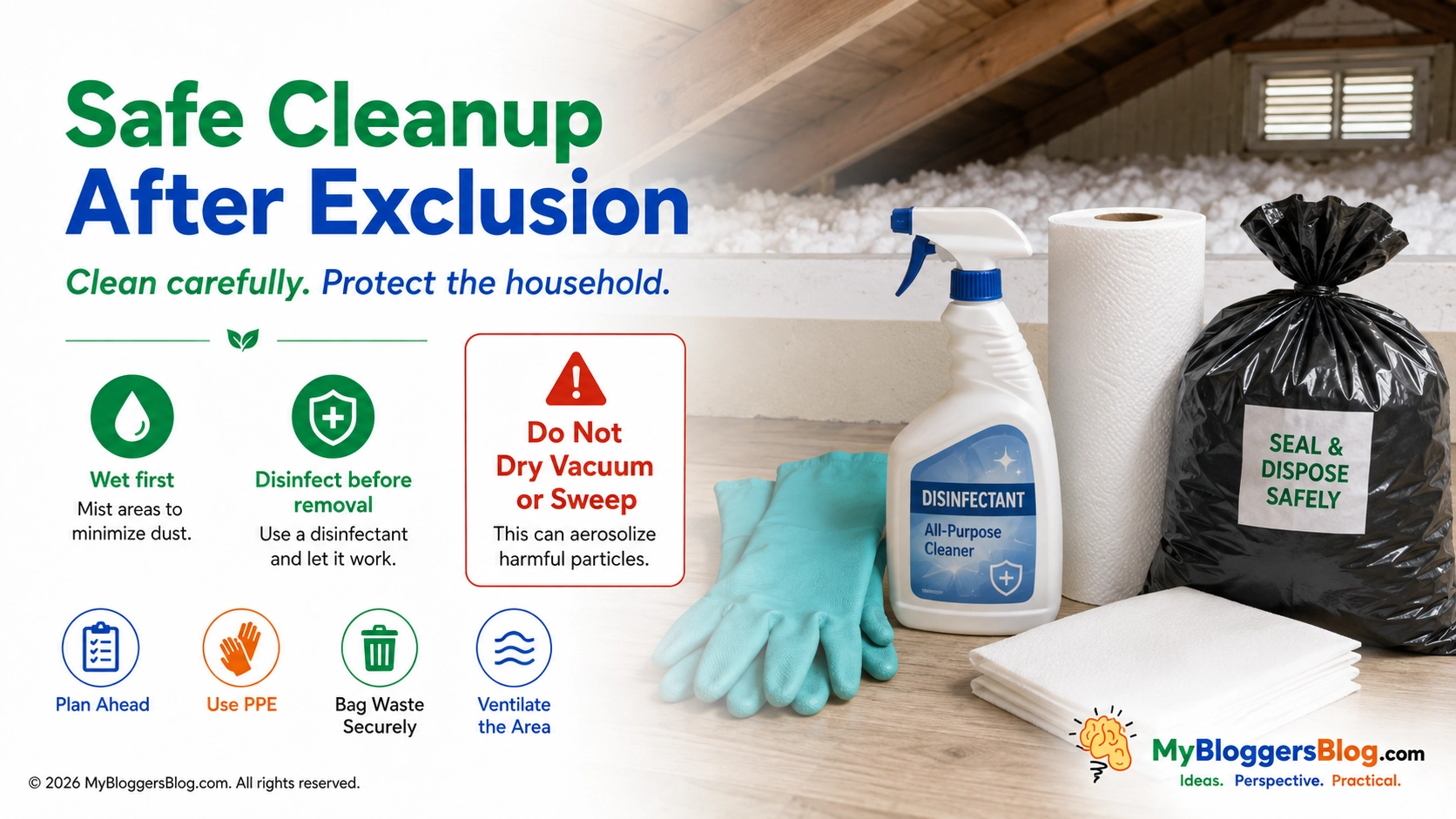
One of the most important CDC instructions is also one of the easiest to violate accidentally: do not sweep or vacuum dry rodent urine, droppings, or nesting material. CDC explains that disturbing contaminated material can put tiny contaminated droplets into the air.
Instead, CDC recommends wet disinfection. Its current homeowner procedure begins with rubber or plastic gloves, thoroughly wetting urine and droppings with an appropriate disinfectant or bleach solution, allowing the required contact time, wiping the material up with paper towels, cleaning surrounding hard surfaces, and washing gloved and bare hands appropriately.
CDC also addresses contaminated insulation. If exposed insulation contains rodent urine or droppings, the agency says it should be placed in plastic bags for removal. This does not mean that every rodent observation automatically requires replacement of an entire attic's insulation. The amount and distribution of contamination matter, and heavy or inaccessible contamination may justify professional remediation.
For buildings with extensive rodent activity, CDC recommends additional precautions. Evidence that rodents have accessed heating and cooling ventilation systems is another reason to obtain professional assistance. The key principle is to avoid turning cleanup into an airborne exposure event.
There is an important distinction here. This article rejects toxic substances used to poison or injure the animal. That does not mean rejecting disinfectants used after the animal has left. Public-health sanitation and animal poisoning are completely different purposes. A humane exclusion plan should protect both sides of the conflict: the animal is not intentionally harmed, and the human living space is cleaned responsibly.
When professional help is the better choice
Humane exclusion can be straightforward when there is one accessible defect and light, localized evidence. It becomes substantially more complicated when the attic is difficult to enter, the roof is steep, several openings are active, contamination is extensive, wiring or ducts have been damaged, young may be present, or the animal cannot be confidently identified.
EPA advises homeowners who hire rodent-control professionals to choose carefully and ask to see the company's license. EPA also recommends professionals with experience in integrated pest management. For the approach described here, licensing is only the first filter. The homeowner should also determine whether the company actually performs structural exclusion without rodenticide or intentional killing.
Search terms such as “wildlife exclusion,” “structural rodent exclusion,” “humane wildlife exclusion,” or “rodent proofing” may be more useful than simply searching for extermination. But the company's advertising language should never substitute for a direct written scope of work.
A qualified provider for this project should be able to:
- inspect the full exterior and relevant interior portions of the building;
- identify active and potential entry points;
- photograph or document those points before work begins;
- explain how animals currently inside will be allowed to leave;
- describe how dependent young will be addressed if discovered;
- close secondary openings with durable, rodent-resistant materials;
- use a suitable controlled or one-way exit where the structure and species allow it;
- monitor activity and verify vacancy before the final opening is sealed;
- inspect insulation, wiring, ducts, vents, and structural areas for damage or contamination;
- follow public-health guidance for cleanup or refer specialized remediation when necessary;
- provide final photographs or an exclusion report;
- state what repair warranty, if any, applies to the exclusion work.
One question reveals a great deal about the provider's philosophy:
“How will you get the rats or mice out and keep them out without poison, toxic bait, intentional killing, or sealing animals inside?”
The answer should describe inspection, sequencing, exclusion, verification, and repair. If the answer immediately turns to bait, killing, or recurring chemical control, the provider is proposing a different service from the one described in this article.
Specify exactly what the contractor may and may not do
Homeowners who want a strictly humane project should make that requirement part of the written proposal, not an informal conversation after the crew arrives. Pest and wildlife companies often offer several control methods. A humane customer should remove ambiguity before authorizing the work.
A useful scope statement is:
Requested service: structural rodent inspection, nonlethal humane eviction, one-way or controlled exclusion where appropriate, permanent rodent-proof repair, and safe post-exclusion cleanup. No rodenticide, toxic bait, poison, glue trap, lethal trap, fumigant, or intentional killing is authorized. No active opening is to be permanently sealed until reasonable steps have been taken to verify that animals and dependent young are not being trapped inside.
The written proposal should then answer these questions:
- What species does the company believe is present, and what evidence supports that conclusion?
- Where are the confirmed or suspected entry points?
- Which openings will be sealed immediately, and which will remain part of the exit plan?
- What rodent-resistant materials will be used at each repair?
- How will required roof, attic, HVAC, plumbing, dryer, or combustion ventilation remain functional?
- How will the company determine whether young are present?
- How will animals inside be allowed to leave?
- How will departure be monitored and verified?
- What evidence will trigger final closure of the last opening?
- What contamination will be cleaned, and by what procedure?
- Will damaged insulation, wiring, ductwork, or roof components be inspected or referred to the appropriate trade?
- What follow-up inspection is included?
- What is covered by the exclusion warranty, and for how long?
That level of specificity protects the homeowner as much as the animal. It converts “humane” from a marketing adjective into a defined work standard.
Verification and long-term monitoring
A quiet attic is encouraging, but silence by itself is not proof that the problem is finished. Rodents are often active when people are not present, and activity may vary with weather, food availability, disturbance, and nesting behavior.
The National Park Service treats inspection and monitoring as continuing parts of rodent exclusion. Its manual notes that building settlement, weather, construction, and site use can affect the integrity of repairs over time. That means success has two different verification points:
- Vacancy verification: reasonable evidence that animals are no longer occupying the excluded area before the final active opening is permanently sealed.
- Building verification: follow-up inspection confirming that repaired openings remain tight and that no new access route has appeared.
After the project, watch for fresh droppings, new gnawing, disturbed insulation, rub marks, scratching sounds, reopened repair edges, damaged screens, or new gaps around roof and utility work. Reinspect after major storms, roof repairs, siding work, new cable or utility installation, HVAC changes, or other construction that penetrates the building envelope.
Vegetation also changes. A branch that was several feet from the roof after pruning may eventually touch the structure again. Vines can re-establish. Screens corrode or loosen. Door sweeps wear. Sealants shrink. A humane exclusion strategy remains humane and effective when ordinary property maintenance keeps those pathways closed before another animal moves in.
The same philosophy, but not the same rules, for other wildlife
The core idea in this article is broader than rats and mice: when an animal is using a human structure for shelter, the most elegant resolution is often to remove access to the structure rather than harm the animal. Official wildlife agencies routinely use exclusion as part of guidance for animals occupying buildings.
But the details are species specific. Bats have maternity seasons and disease considerations. Squirrels, raccoons, birds, snakes, and other wildlife may be protected by different state or federal laws. Some species require licensed professionals, specific exclusion timing, rehabilitation assistance, or special handling. New Jersey Fish & Wildlife, for example, directs residents to species-specific resources and licensed wildlife rehabilitators when injured or orphaned native wildlife is involved.
Therefore, do not assume that a rodent exclusion detail can simply be copied for every attic animal. First identify the species. Then check the wildlife and public-health rules for the state and locality. The humane philosophy can remain constant even when the legal and biological procedures change.
Conclusion: close the door, permanently
There is a fundamental difference between removing a rodent and solving a rodent problem.
Removing an individual changes one moment. Structural exclusion changes the building.
A humane strategy begins by accepting that the rat or mouse does not have to die simply because it found a defect in a house. The practical response is to identify the defect, understand how the animal is using it, preserve a safe way out, avoid abandoning dependent young, close alternative routes, verify departure, and convert every relevant opening into a durable rodent-resistant part of the building envelope.
Then remove the conditions that encourage return. Secure food and garbage. Manage bird seed and pet food. Reduce vegetation routes. Repair water sources. Clean contamination carefully. Inspect the work again.
This approach is compassionate, but it is not passive. It requires more attention to construction, sequencing, verification, and maintenance than simply putting something in the attic and waiting. That is precisely why it can provide a better long-term answer.
Authoritative references
This article intentionally relies on government and public-agency guidance rather than commercial pest-control marketing. Source material was reviewed for the humane-exclusion, building-repair, household-safety, and cleanup principles discussed above.
- Centers for Disease Control and Prevention. “How to Seal Up to Prevent Rodents.” CDC Healthy Pets, Healthy People.
- Centers for Disease Control and Prevention. “How to Clean Up After Rodents.” CDC Healthy Pets, Healthy People.
- Centers for Disease Control and Prevention. “How to Trap Up to Remove Rodents.” Used in this article only for CDC's household-safety warning concerning glue and live traps. CDC Healthy Pets, Healthy People.
- Centers for Disease Control and Prevention. “Hantavirus Prevention.” CDC.
- U.S. Environmental Protection Agency. “About Rats and Mice.” EPA.
- U.S. Environmental Protection Agency. “Identify and Prevent Rodent Infestations.” EPA.
- U.S. Environmental Protection Agency. “Rodent Control Pesticide Safety Review.” EPA.
- U.S. Environmental Protection Agency. “Safely Use Rodent Bait Products.” Used to document risks to people, children, pets, and non-target wildlife; rodenticide is not recommended by this article. EPA.
- U.S. Environmental Protection Agency. “Tips for Hiring a Rodent Control Professional.” EPA.
- National Park Service, U.S. Department of the Interior. Rodent Exclusion Manual: Mechanical Rodent Proofing Techniques. NPS technical manual.
- Maine Department of Inland Fisheries and Wildlife. “Evicting Animals From Buildings.” Maine IFW.
- New Jersey Department of Environmental Protection, Fish & Wildlife. Wildlife Relocation Policy. NJ Fish & Wildlife.
- New Jersey Department of Environmental Protection, Fish & Wildlife. “Need Help With Wildlife?” NJ Fish & Wildlife.