
Does Every Maintenance Medication Really Need a Daily Dose?
Modern medicine has become very good at determining what drug to use and how much to prescribe. But another question deserves much more attention: how often does that medication really need to be taken, and does the schedule still make sense once half life, pharmacokinetics, physiology, patient comfort, cost, and system impact are taken seriously? This article begins with Levothyroxine Sodium as a case study, then widens into a larger challenge for long term maintenance medications.

Why this question deserves to be asked
Millions of people take maintenance medications every day because daily dosing became the accepted standard. Yet the world around that standard has changed. Pharmacology is better understood. Human physiology is better understood. Manufacturing and supply chains are more visible than ever. Environmental costs are harder to ignore. Computational analysis and AI can now connect established facts and raise questions that traditional habit may never have prioritized.
This does not mean daily schedules are wrong. It means long term medications deserve to be periodically reexamined, not with the reckless goal of simply cutting treatment, but with a disciplined goal: could the same therapeutic result sometimes be achieved with fewer administration events or a longer interval between doses?
If the answer is yes even in a limited subset of medications or patients, the consequences could extend far beyond the pill itself. Patient routines could become easier. Administration errors and interaction opportunities could decrease. Fewer tablets might be manufactured, packaged, shipped, handled, stored, and discarded. In aggregate, that could affect cost, waste, and environmental burden in ways that medicine has not fully quantified.
Why Levothyroxine Sodium is a compelling starting point
Levothyroxine is a particularly interesting example because several important facts sit side by side.
- It is one of the most commonly prescribed maintenance medications.
- It represents synthetic T4, a thyroid hormone with a long biological half life.
- It is highly protein bound, which supports a circulating hormone reservoir rather than an immediate on and off effect.
- Much of the body’s circulating T3 is generated through peripheral conversion of T4.
- It must usually be taken under specific administration conditions, which makes the daily routine more burdensome than many other tablets.
Put simply, Levothyroxine is not a short acting drug that quickly disappears a few hours after swallowing a tablet. It is much closer to a slow moving hormone reservoir. That makes it an ideal candidate for asking whether the calendar interval between tablets always deserves to remain fixed at one day.

Half life changes the conversation
For the purpose of this discussion, the key pharmacokinetic anchor is the commonly cited Levothyroxine half life of roughly seven days in hypothyroid patients, with official sources describing a multi day half life and a somewhat shorter average in euthyroid individuals. The exact number can vary, but the general point remains the same: T4 persists for days, not hours.
That has an immediate mathematical consequence. Using a seven and a half day half life as an analytical model, the amount remaining after a dose declines gradually:
- After 1 day, about 91 percent remains.
- After 2 days, about 83 percent remains.
- After 3 days, about 76 percent remains.
- After 4 days, about 69 percent remains.
- After 7 days, about 52 percent remains.
These figures do not mean that a single intact tablet is still sitting in the body. They simply illustrate the underlying principle of a long lived hormone pool. Missing one calendar day is not even remotely the same thing as having no hormone present. Repeated dosing builds a reservoir, and each new dose arrives in a body that is already carrying substantial hormone from earlier doses.
A useful case study: the stable 25 mcg maintenance patient
Suppose a patient has been stable on a true long term maintenance dose of 25 mcg per day. That matters because a 25 mcg tablet can also be used as a starting or titration dose. Here we are speaking specifically about an established maintenance requirement.
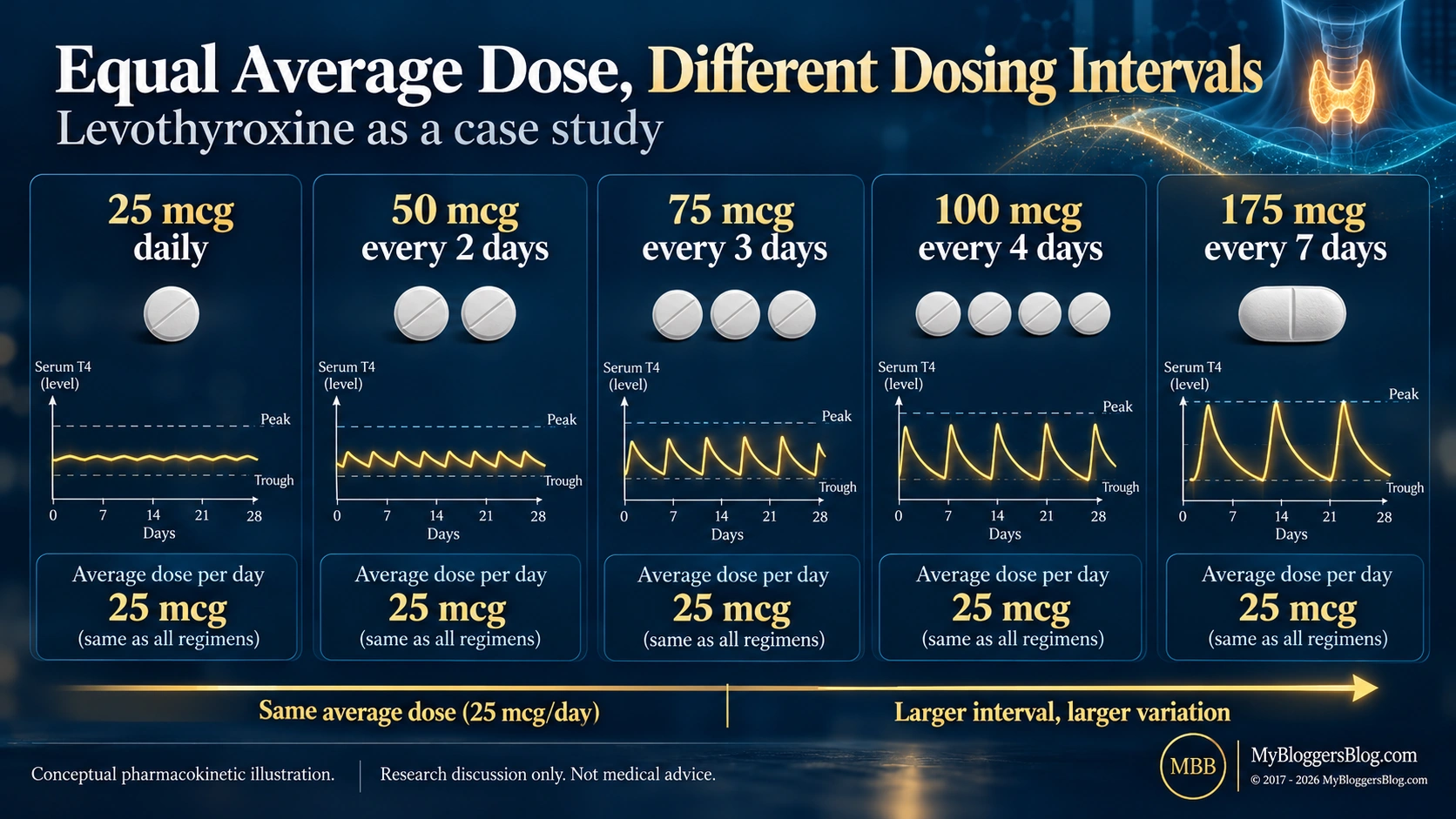
Over twelve days, the conventional regimen supplies 300 mcg in total. That same total amount can be redistributed in several mathematically equivalent ways:
| Schedule | Dose per administration | Administrations in 12 days | Total LT4 in 12 days | Average per day |
|---|---|---|---|---|
| 25 mcg daily | 25 mcg | 12 | 300 mcg | 25 mcg per day |
| 50 mcg every 2 days | 50 mcg | 6 | 300 mcg | 25 mcg per day |
| 75 mcg every 3 days | 75 mcg | 4 | 300 mcg | 25 mcg per day |
| 100 mcg every 4 days | 100 mcg | 3 | 300 mcg | 25 mcg per day |
| 175 mcg every 7 days | 175 mcg | about 1.7 | about 300 mcg in 12 days equivalent | 25 mcg per day |
The average amount stays the same. What changes is the shape of the concentration curve. Daily dosing produces the smoothest pattern. As the interval gets longer, the difference between post dose peaks and pre dose troughs becomes larger.
What the pharmacokinetic comparison suggests
When the same average dose is redistributed across longer intervals, a clear continuum appears.
| Regimen | Conceptual pattern | What it suggests |
|---|---|---|
| 25 mcg daily | Very low peak to trough variation | Closest to a smooth steady state |
| 50 mcg every 2 days | Modest variation | Still pharmacokinetically very conservative |
| 75 mcg every 3 days | Noticeable but moderate variation | A plausible middle ground worth formal study |
| 100 mcg every 4 days | Larger variation | Convenience improves further, but oscillation widens |
| 175 mcg every 7 days | Largest variation | Most aggressive interval, with the greatest peak and trough swings |
This does not prove that any particular interval is clinically best. It does show that medicine may have paid too little attention to the enormous territory between daily and weekly dosing. Once weekly dosing has been studied before, often in the context of adherence. The underexplored zone may actually be the middle ground between 1 day and 7 days.
There is also an important physiological nuance. A low stable dose such as 25 mcg per day may indicate that some patients are receiving partial support rather than full replacement. In such a case, the exogenous medication may represent only part of total thyroid hormone availability, while endogenous production, protein binding, and peripheral conversion continue to contribute. That possibility strengthens the case for better stratified research rather than a one size fits all assumption.
The burden of the daily routine
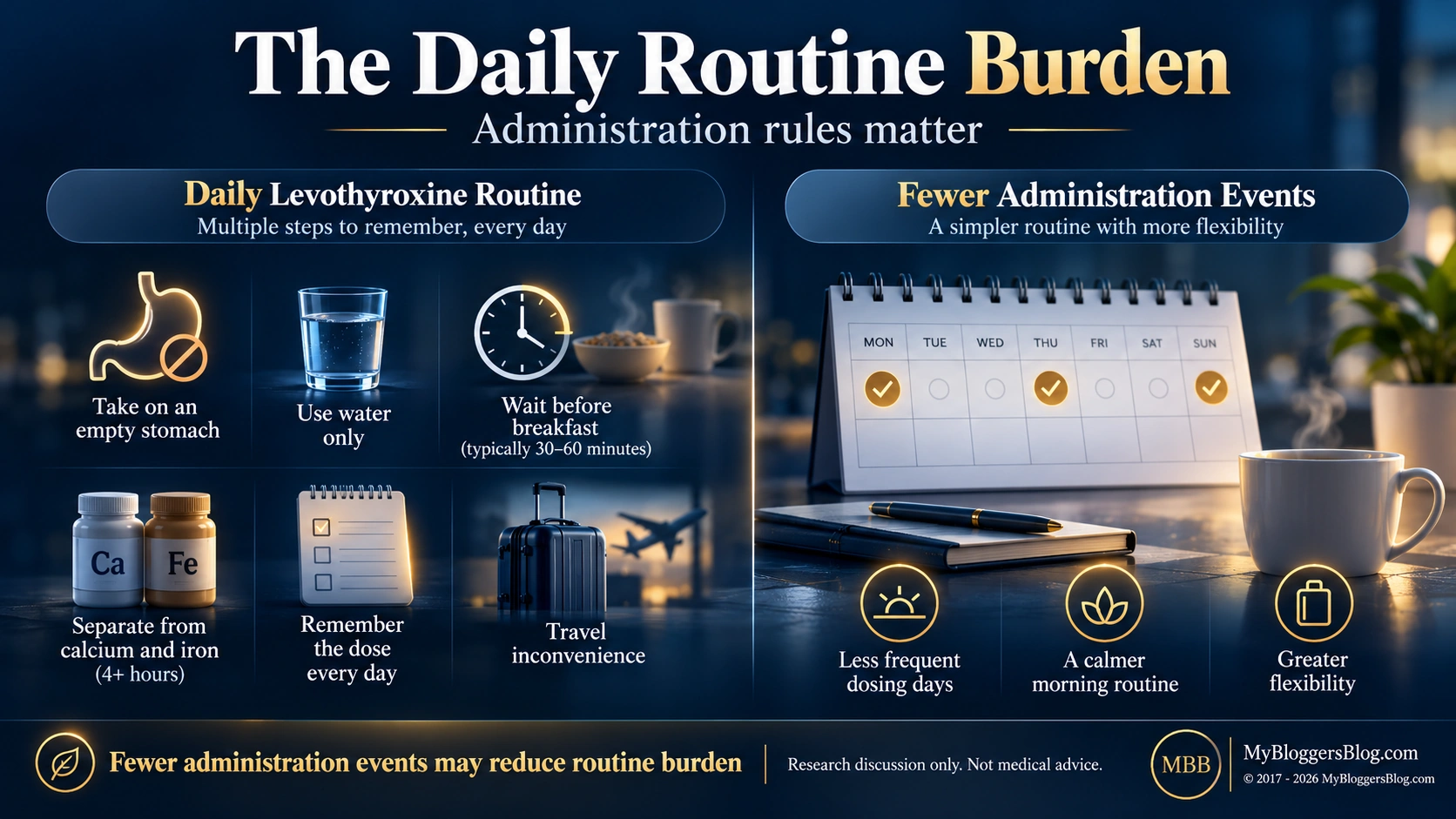
Levothyroxine is an unusually good example of how a very small tablet can create a very large daily footprint.
- It is commonly taken on an empty stomach.
- It is commonly taken with water only.
- Breakfast is often delayed to reduce absorption interference.
- Calcium and iron usually need separation by several hours.
- The patient must remember the dose and remember whether it was already taken.
- Travel, early meetings, social schedules, and other medications can complicate the routine further.
If a less frequent schedule could preserve acceptable physiological control in selected patients, the daily administrative burden would drop sharply. Three out of four mornings might no longer involve a Levothyroxine administration event. That does not eliminate the hormone’s biological effect on those days. It does eliminate the repeated absorption ritual.
Why the economic and environmental question matters
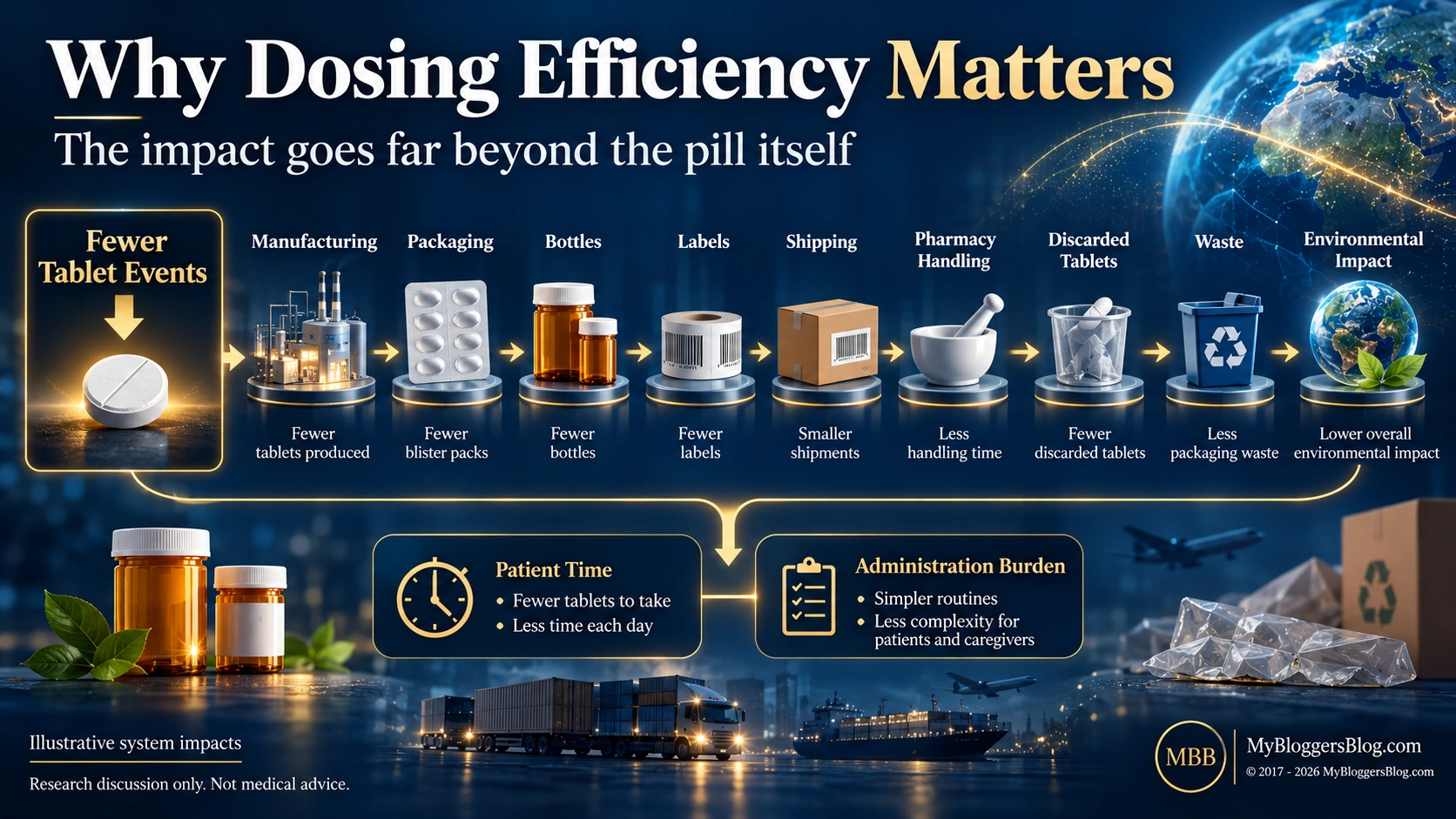
It is easy to underestimate the broader impact because Levothyroxine itself is an inexpensive generic. Yet low price per pill does not mean low system impact. Much of the system cost attaches not to the micrograms inside the tablet, but to the fact that a tablet exists at all and must be manufactured, quality checked, packaged, labeled, bottled, shipped, stored, dispensed, handled, remembered, and eventually discarded if unused.
If the same average therapeutic exposure can be delivered using fewer tablet events, the potential downstream effects include fewer finished tablets, less packaging, fewer bottles and labels, less transportation volume, lower disposal burden, fewer opportunities for routine errors, and less material waste. The true dollar impact is unknown and almost certainly varies depending on what one counts. Direct drug acquisition savings alone may be modest relative to total healthcare spending. The broader societal value, including patient time and system friction, may be much larger.
Environmental effects should also not be dismissed. Fewer bottles, caps, cartons, labels, blister packs, and discarded tablets would mean less material moving through the chain. Even a modest percentage reduction, applied to millions of long term medication users, could become very significant over time.

Why these questions may be underexamined
There is also a structural issue that deserves to be acknowledged calmly and honestly. Clinical evidence can only answer the questions that researchers choose to study. If studies are designed to show that a medication works at a specific dose and schedule, then that is the evidence base that reaches clinicians and regulators. If nobody asks whether the same result could sometimes be achieved with fewer administration events, that possibility does not naturally appear in the final prescribing culture.
This is not an accusation of fraud or bad faith. It is a point about incentives. Manufacturers have obvious reasons to prove that a drug is safe and effective under an approvable regimen. There may be much less commercial incentive to fund studies whose successful result could imply fewer finished tablets, fewer doses, or lower overall utilization. That is precisely why some efficiency questions may need stronger independent academic and public interest attention.
What a proper research program should test
If medicine takes this question seriously, the goal should not be internet experimentation. The goal should be proper study design.
- Stable patient populations should be defined carefully.
- Residual thyroid function should be considered.
- Equal average dose schedules should be compared head to head.
- TSH, FT4, FT3, symptoms, heart rate, sleep, weight, and patient preference should be measured.
- Administration burden, adherence, timing errors, and quality of life should be recorded.
- Economic and environmental impacts should be modeled explicitly rather than guessed.
A thoughtful research sequence might begin with the middle ground: daily, every 2 days, every 3 days, and every 4 days, especially in carefully selected stable low dose patients. The answer may prove that daily dosing remains best. It may also prove that some patients can safely tolerate longer intervals. Right now, the point is not that we know the answer. The point is that the question is strong enough to deserve the trial.
The bigger question for medicine
Levothyroxine is only the beginning. The deeper question is whether other long half life maintenance medications are also living inside inherited schedules that were good enough to become standard, but never fully revisited once better pharmacology, better analytics, better modeling, and better system awareness became available.
Some medications will never qualify for this kind of reexamination. Some need stable daily concentrations. Some produce unacceptable peaks. Some have nonlinear kinetics or narrow safety margins that limit flexibility. But the principle still stands: dosing interval should be a scientific variable, not a historical relic.
When better questions are asked, medicine improves. Sometimes the breakthrough is a new molecule. Sometimes it is a better way to use an old one.
Selected sources and notes
- DailyMed, U.S. National Library of Medicine. Levothyroxine Sodium tablet labeling and administration guidance.
- NCBI Bookshelf and StatPearls reviews on Levothyroxine pharmacology, pharmacokinetics, protein binding, and dosing principles.
- PubMed indexed studies comparing daily and less frequent Levothyroxine dosing, including weekly and other non daily schedules.
- CMS NADAC and related public drug cost resources for tablet level acquisition context.
- The analytical comparisons in this article are author generated extrapolations built on published pharmacokinetic concepts. They are included to illustrate what should be studied. They do not substitute for clinical judgment or laboratory monitoring.
- V