
Swedish Death Cleaning in a few minutes
Swedish Death Cleaning is the practice of reviewing your possessions before death, not necessarily because death is near, but because you are still alive and able to make the decisions yourself. The Swedish verb döstäda is defined by the Swedish Academy as cleaning and disposing of possessions before one's own death, usually to make the eventual work easier for survivors. The word is documented in Swedish usage from 1998. It became internationally famous after Swedish artist and author Margareta Magnusson published Döstädning: ingen sorglig historia in 2017.
The principle is simple: if you no longer need, use, value or understand why you are keeping something, consider whether it should remain in your life. If an object matters, preserve it intentionally. If it belongs with somebody else, ask them rather than assuming. If it has a story, attach the story. If it is private, decide whether it should survive you. If it is valuable, identify it. If it is useless, unsafe or obsolete, dispose of it responsibly.
What it is, and what it is not
Death Cleaning overlaps with ordinary decluttering, but its purpose is different. Ordinary decluttering asks whether your home works better with fewer things. Death Cleaning adds another question: what would happen to this if I were not here to explain it?
It is also not minimalism. You can own books, art, tools, collections and family objects and still be well prepared if the contents of your life are deliberate, understandable and manageable. The goal is not an empty room. The goal is fewer unexplained obligations.
It is not estate planning either. A beautifully organized house does not replace a will, power of attorney, advance health care documents, beneficiary designations, financial records or the legal administration of an estate. Think of Death Cleaning as one practical layer of broader life and estate preparation.
How to begin without making it overwhelming
Do not begin with the most emotional box in the house. Begin where decisions are easy. Clothing that no longer fits, duplicate kitchen items, unused household goods, obsolete electronics, abandoned hobbies and obvious rubbish usually create momentum without turning the first session into an autobiography.
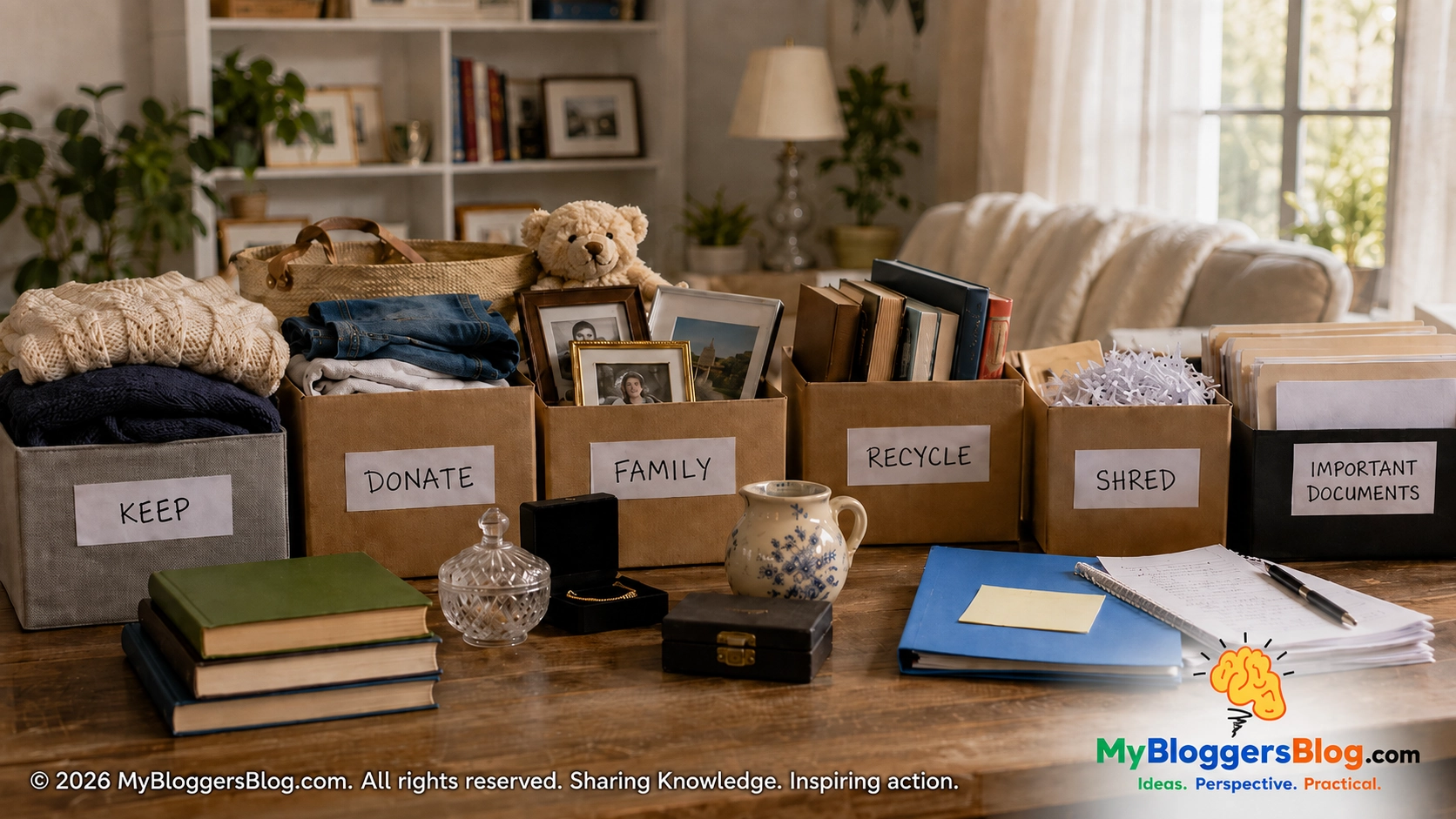
A simple decision system is enough:
- Keep and use: it has a real place in your current life.
- Give: a specific person genuinely wants it.
- Sell: the expected value justifies the time and work.
- Donate: it is useful and suitable for reuse.
- Recycle: it belongs in an appropriate recycling stream.
- Securely destroy: it contains sensitive personal or financial information that no longer needs to be retained.
- Dispose safely: it is hazardous, expired, broken or unsuitable for reuse.
- Decide later: use this category sparingly and give it a deadline.
Work in small areas, finish each area and actually move outgoing material out of the home. A pile labeled "donate" that remains in the basement for four years is not Death Cleaning. It is relabeled storage.
The things a simple decluttering session can miss
The physical house is only one part of a modern life. A complete version should also address:
- important documents, financial records, insurance and account information;
- digital photographs, cloud storage, email, social media and online subscriptions;
- password management and provider-specific legacy tools;
- jewelry, art, coins, collectibles and objects whose value may not be obvious;
- family heirlooms and the stories that explain why ordinary-looking things matter;
- confidential papers, diaries, private photographs and information involving other people;
- old medicines, chemicals, paints, batteries and other materials that require safe disposal;
- trip hazards and excess furniture that may matter to aging safely at home;
- legal estate documents and advance care planning that are outside the scope of decluttering itself.
Most importantly, ask rather than assign. Your children may not want the china, piano, furniture or collection you have imagined them inheriting. Another relative may treasure something you assumed nobody noticed. Conversations held while everyone is alive are easier than guesses made after somebody is gone.
If that is enough, you already have the concept. The rest of this article is for the reader who wants the entire machinery behind it.
Swedish Death Cleaning, in detail
This section deliberately revisits the subject from the beginning. It is designed to stand as the detailed version, not as a collection of footnotes to the short version above.
Where döstädning came from
The popular version of the story is that Margareta Magnusson invented Swedish Death Cleaning in 2017. The documentary record is more interesting.
The Swedish Academy's Svensk ordbok lists döstäda, also written dödstäda, and defines its first meaning as cleaning and getting rid of possessions before one's own death, normally to make the work easier for surviving relatives. That usage is recorded as being attested since 1998. The same dictionary gives a second meaning, cleaning out the home of a person who has already died, attested since 2017.
There is also pre-2017 evidence from Sweden's Institute for Language and Folklore. In an archived 2016 account, a Gothenburg woman born in 1929 discusses her own collecting and explicitly refers to ongoing "döstädning," including the transfer of porcelain, household objects and jewelry to children and grandchildren.
Magnusson's importance is therefore not that she created the human behavior from nothing. Her achievement was to turn an existing Swedish expression and recognizable practice into a coherent, humorous and internationally portable idea. Her 2017 book, Döstädning: ingen sorglig historia, was published by Albert Bonniers Förlag and later appeared in English as The Gentle Art of Swedish Death Cleaning.
The expression also appeared on Sweden's 2017 new-word list. A "new word" list does not prove that a word was literally invented that year. Such lists also capture words that suddenly become unusually visible or culturally important. That is exactly what happened with döstäda.
This distinction matters because Swedish Death Cleaning is sometimes marketed as an ancient Scandinavian ritual passed down unchanged through centuries. The evidence does not support that romantic story. Ethnologist Lynn Åkesson of Lund University has instead connected the contemporary practice to modern abundance, changing household ideals and consumer society.
Historically, possession could signal prosperity. Åkesson notes accounts from around 1900 in which well-filled cupboards could signify competent housekeeping and material success. Modern affluent households have a different problem: the quantity of inexpensive, replaceable, specialized and digitally connected possessions can become so large that the final household itself becomes a substantial administrative project.
That makes Death Cleaning a modern response to a modern condition. The problem is not merely mortality. The problem is mortality plus abundance.
What the philosophy is really trying to do
At the most superficial level, Death Cleaning removes stuff. At a deeper level, it reduces unresolved decisions.
Every unexplained possession can become a decision transferred to somebody else. A folder of unknown papers, an unlabeled key, a locked device, a box of jewelry, a storage unit, an old bank statement, a collection, a safe-deposit key, an expensive watch that looks inexpensive, a hard drive and a stack of letters all require interpretation.
The owner can answer questions that an executor, child, spouse or friend may not be able to answer:
- Why is this here?
- Does it have financial value?
- Does it have family meaning?
- Does somebody already expect to receive it?
- Is there a loan, warranty, title, insurance policy or tax record connected to it?
- Is it confidential?
- Can it be donated safely?
- Does it require specialist disposal?
- Would destroying it erase the only copy of an important record or family story?
Death Cleaning moves those decisions forward in time, into a period when the person who knows the answers can still participate.
That is why the practice can be generous without becoming self-erasure. The ideal is not "leave nothing." The ideal is "leave less confusion."
Possessions, identity and psychology: why throwing things away is not the whole answer
Popular decluttering culture often treats possessions as a simple burden: fewer objects equals more peace. Research on aging and material possessions is more nuanced.
A peer-reviewed study of 450 adults, half aged 65 or older, found that greater perceived clutter was associated with poorer psychological home and subjective well-being. That does not establish that removing objects will automatically improve mental health, because the study was observational. It does show that clutter can be experienced as more than a visual inconvenience.
At the same time, research in The Gerontologist found that cherished possessions can connect older adults with earlier identities, provide comfort during change and, in some cases, support a sense of aging in place. For some participants, possessions were disruptive; for others they were stabilizing. The lesson is not that possessions are good or bad. Their role depends on meaning, quantity, accessibility and the person's relationship with them.
Research by gerontologist David Ekerdt and colleagues uses the concept of a material convoy: possessions accumulate across adult life as equipment for roles, relationships and identities. Work clothes, children's furniture, hobby equipment, travel objects, inherited items, tools, books and household goods accompany different stages of life. When the roles change, the objects do not automatically leave.
Another Ekerdt study describes the "safe passage" of cherished possessions. Older adults sometimes work deliberately to place meaningful objects with people who will appreciate them. This is more than disposal. It can be a final act of stewardship.
That leads to a better Death Cleaning question than "Does this spark joy?" For an aging household, a more complete set is:
- Does this serve my present life?
- Does this connect me to something important?
- Would losing it actually diminish my daily life or identity?
- Is it safe and manageable in my home?
- Does somebody else value it more than I do?
- Would another person understand why it matters if I were not here?
When should someone start?
Death Cleaning is often mistaken for a project reserved for the final months of life. That is arguably the worst time to begin a lifetime-sized project.
Research using U.S. Health and Retirement Study data found that people became progressively less likely to divest possessions after age 50. After age 70, about 30 percent reported doing nothing in the previous year to clean out, give away or donate belongings, and more than 80 percent had sold nothing. The finding does not mean that age itself makes people unwilling to simplify, but it undermines the assumption that everyone naturally starts unloading possessions as old age advances.
There are several practical reasons to start while healthy:
- lifting, sorting, carrying and driving donations require physical energy;
- selling items requires photographs, descriptions, pricing, communication and sometimes shipping;
- large volumes of possessions create decision fatigue;
- a spouse or relative who knows the history of an object may not always be available later;
- downsizing under a medical or housing deadline can turn thoughtful decisions into emergency disposal;
- family members can discuss intended gifts before misunderstandings become inheritance disputes.
A sensible starting point is therefore not a particular birthday. It is the moment when a person has accumulated enough history that simplifying today can make tomorrow easier. For some people that may be in their forties or fifties. For others it begins with retirement, a move, widowhood, a major renovation, children establishing their own homes, or the realization that several rooms contain objects nobody actively uses.
The five layers of modern Death Cleaning
Magnusson's original concept grew from tangible possessions. A twenty-first-century life needs a wider framework. A complete Death Cleaning effort can be divided into five layers.
1. Physical
Furniture, clothes, books, tools, art, kitchenware, collections, storage, vehicles and ordinary household possessions.
2. Documentary
Legal, financial, tax, medical, insurance, property, identity and family records, both paper and scanned.
3. Digital
Email, photographs, phones, computers, cloud storage, social media, subscriptions, online financial access, domains and digital property.
4. Administrative
Accounts, recurring bills, memberships, insurance contacts, service providers, beneficiary information and instructions another person may need.
5. Legacy and privacy
Heirlooms, stories, private correspondence, confidential records, family history, intended gifts and material that should either survive with context or be securely destroyed.
Formal estate planning and advance care planning sit beside these five layers. They interact with Death Cleaning, but they should not be confused with it.
A complete working method
Stage 1: Define the objective
Write down why you are doing this. A useful objective might be: "I want my home to support my present life, I want important objects and information to be understandable, and I do not want my family to spend months sorting avoidable clutter after I die."
That prevents the project from deteriorating into indiscriminate purging.
Stage 2: Create destination rules before opening boxes
Decide in advance where outgoing material can actually go. Identify donation organizations, recycling options, municipal hazardous-waste rules, medication take-back locations, a shredding method, possible buyers and family members who may want specific categories.
The destination system is as important as the sorting system. Otherwise the home simply develops new piles labeled "deal with later."
Stage 3: Begin with low-emotion, high-volume categories
Examples include duplicate kitchenware, linens beyond realistic needs, old toiletries, obsolete cables, unused small appliances, worn clothing, empty boxes, abandoned craft supplies and expired household products.
Do not begin with photographs of deceased relatives, love letters, children's first shoes or the only remaining possessions of a parent. Those items can stop the process before it begins.
Stage 4: Separate decision types
Do not try to answer every question at once. A useful sequence is:
- Is it obviously rubbish, broken or unsafe? Route it to proper disposal.
- Do I actively use it? Keep it accessible.
- Does it carry genuine meaning? Keep it, document it or choose a recipient.
- Is it valuable? Identify and document before deciding disposition.
- Does it contain sensitive information? Retain securely or destroy securely.
- Does it belong to somebody else? Return it.
- Would somebody specifically want it? Ask.
- Could it be reused? Give, sell or donate.
- Am I postponing because I am tired? Stop for the day rather than make poor decisions.
Stage 5: Finish one physical area at a time
A finished closet is psychologically and practically more useful than twelve half-sorted rooms. Remove outgoing material promptly and record anything important that was transferred.
Stage 6: Create a household map
For larger homes, write a simple inventory of locations that another person would otherwise have to discover: safe, filing cabinet, attic, basement storage, garage cabinets, off-site storage, safe-deposit box, spare keys, vehicle titles, jewelry, artwork records, external hard drives and emergency contacts.
Stage 7: Build an information binder or secure digital equivalent
This is not the place to put every password in plain text. It is a map explaining what exists, where authoritative documents are stored, who the advisers are, which institutions matter and how the legally authorized person can begin.
Stage 8: Revisit annually
A single heroic purge followed by ten years of reacquisition defeats the purpose. Death Cleaning works better as periodic maintenance than as one dramatic event.
Detailed category-by-category guide
Clothing and shoes
Separate current everyday clothing from formal wear, seasonal clothing, sentimental garments and obsolete sizes. Donate clean usable items. Recycle textiles where local programs accept them. Keep genuinely meaningful garments if they matter, but do not confuse "I remember wearing this" with "I need to preserve every item I ever wore."
Kitchen and dining
Look for duplicates: multiple sets of measuring cups, serving dishes, glasses, small appliances, storage containers, knives and cookware. Formal china and specialty pieces deserve an explicit family conversation. Do not assume younger relatives want a full set simply because it was expensive or traditionally considered heirloom material.
Books, magazines and media
Separate reference material you still use from books you value as objects and books that merely stayed because shelves existed. Check for inscriptions, first editions or family annotations before mass donation. Old photographs, letters and documents can hide inside books. Libraries and charities have different donation rules, so verify locally before transporting boxes.
Furniture
Ask whether each piece serves current life, creates a hazard, blocks circulation or exists only because moving it is difficult. Large furniture can be disproportionately difficult for survivors because disposal may require scheduling, labor and transportation. If a particular piece is intended for a relative, confirm that they want it and can physically accommodate it.
Photographs
Do not merely scan everything and create 40,000 unnamed files. Identification is often more valuable than resolution. Write names, approximate dates, locations and relationships where known. Prioritize unique family photographs and the identities of people who would otherwise become anonymous faces within one generation.
Letters, diaries and personal writing
Decide deliberately whether these are family history, private records, material to be given to a specific person, material suitable for an archive, or material that should be destroyed. A diary is not automatically a gift to descendants merely because it survives the writer.
Jewelry, coins, art and collectibles
Do not dispose based on appearance. Keep appraisals, receipts, authentication documents, provenance, photographs and insurance records with the inventory. If value could be material, obtain appropriate professional advice before gifting, selling or donating.
Tools and hobby equipment
Woodworking, photography, sewing, music, sports and specialist hobbies can create equipment whose value is invisible to nonparticipants. Label specialized items. Identify clubs, schools, professional groups or individuals who could use them. Dangerous tools, fuels, ammunition and regulated materials require separate legal and safety considerations.
Electronics
Old phones, computers, drives and tablets may contain personal data long after they stop being useful. Back up material that should survive, sign out of services where appropriate, follow manufacturer guidance for secure erasure and use proper electronics recycling rather than ordinary household trash where required.
Storage units, attics, basements and garages
These areas often contain the material convoy in concentrated form: previous homes, previous jobs, children's belongings, inherited objects, empty packaging, deferred repairs and forgotten purchases. Treat off-site storage as part of the estate. A unit nobody knows exists can continue billing after death and may contain property no one realizes they own.
Vehicles
Keep titles, loan documentation, insurance information, spare keys, maintenance records and information about any specialty equipment together. Vehicles are titled property, not merely large possessions.
Pets
A pet is not a possession to be "decluttered." Identify who has agreed to care for the animal if you cannot, where veterinary records are kept, medication and feeding information, microchip details and any financial arrangements established under applicable law.
Documents and records: the area where enthusiasm can become expensive
Paper feels like an easy category because old statements and files occupy so much space. It is also a category in which indiscriminate destruction can create legal, tax, identity and estate problems.
The U.S. Federal Trade Commission published updated consumer guidance in 2025 that provides a useful baseline for personal records. It recommends keeping certain routine documents for about a year, tax records for at least three years, ownership-related documents while the property is owned and specified vital records permanently. The FTC also advises shredding documents containing personal or financial information when they are no longer needed.
| FTC baseline category | Examples | Practical Death Cleaning treatment |
|---|---|---|
| Keep about one year | Bank statements, pay stubs, undisputed medical bills, credit card and utility bills, deposited checks | Retain where needed; if reliable electronic access exists, paper copies may often be reduced. |
| Keep at least three years | Income tax returns and supporting tax documents; records related to selling a home | Do not apply a universal three-year rule blindly. The FTC notes the IRS may recommend longer retention in some circumstances. |
| Keep while you own | Vehicle title, home title or deed, loan documents, home improvement receipts, leases, major appliance warranties | Store together and make the location easy for an authorized person to find. |
| Keep permanently | Birth/adoption records, Social Security cards, valid passports and citizenship/residency documents, marriage/divorce records, military records, wills, living wills, powers of attorney, retirement and pension plans, family death certificates and vital health records | Protect from fire, theft and casual disposal. Ensure the right people know how to locate them. |
| Securely destroy when obsolete | ATM receipts, old credit offers, credit reports, expired IDs, expired warranties and unneeded prescription information | Shred or otherwise destroy sensitive information rather than placing intact records in trash or recycling. |
Create an "essential information map"
A useful estate-facing information map can identify, without exposing unnecessary passwords:
- where the original will and other estate documents are stored;
- attorney, accountant, financial adviser and insurance contacts;
- banks and financial institutions used;
- retirement and pension plans;
- life insurance policies;
- real estate and vehicle ownership records;
- safe-deposit boxes and where their access information is maintained;
- business interests;
- recurring obligations and subscriptions;
- location of tax returns and supporting files;
- location of digital-legacy instructions.
Digital Death Cleaning: the invisible estate
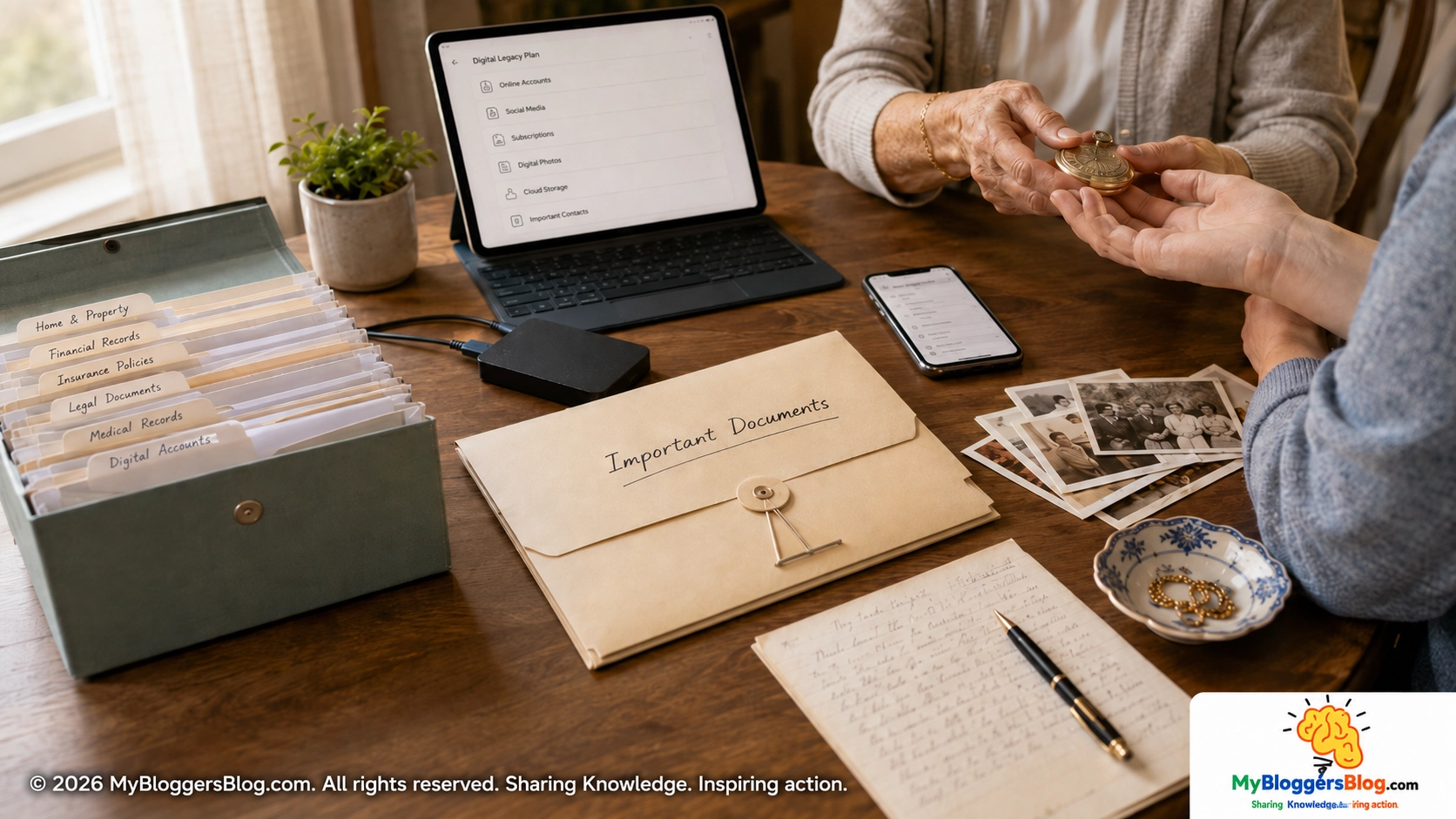
Modern households can look beautifully simplified while hiding an enormous digital estate. Email, cloud storage, photographs, domain names, online subscriptions, brokerage portals, social media, password managers, cryptocurrency, digital books, loyalty accounts, medical portals and business files do not disappear merely because the desk is clean.
Digital legacy should be handled account by account and provider by provider. Ownership, licensing, privacy, encryption and access rights differ. A device passcode is not necessarily legal authority to use every account on the device.
Apple Legacy Contact
Apple allows a user to designate one or more Legacy Contacts. Apple states that a Legacy Contact may be able to access data such as photographs, messages, notes, files and device backups after the user's death. The designated person needs the Legacy Contact access key and proof of death. Some categories are excluded, including purchased media and information stored in iCloud Keychain such as passwords, passkeys and payment information. Apple specifically suggests keeping a copy of the access key with estate-planning documents.
Google Inactive Account Manager
Google provides Inactive Account Manager so a user can determine what should happen after an account has been inactive for a chosen period, including notifying trusted contacts and sharing selected data. Google identifies this as the preferred way to communicate wishes regarding account information. For deceased users without prior arrangements, Google has a separate request process, but it does not simply hand over passwords.
Digital asset law
In the United States, the Revised Uniform Fiduciary Access to Digital Assets Act, or RUFADAA, provides a framework for fiduciary access to digital assets when an account owner dies or loses capacity. State enactment and account-provider rules still matter. This is another reason to coordinate digital instructions with estate counsel rather than relying on a handwritten password list alone.
A digital inventory should consider
- primary email accounts and recovery email addresses;
- mobile phone and computer ecosystems;
- cloud drives and backup services;
- photo libraries;
- social media accounts;
- password manager and emergency access features;
- banking and investment portals;
- payment services;
- subscription services and recurring charges;
- online shopping accounts with stored balances or credits;
- domain names and web hosting;
- business or professional accounts;
- cryptocurrency and digital wallets, where applicable;
- loyalty, airline and hotel programs;
- medical and insurance portals;
- digital creative work, manuscripts, photographs, source files and intellectual property.
The objective is not to print every password. It is to make sure the legally authorized person knows what exists, which tools you configured, where access instructions are securely stored and which data should be preserved or deleted.
Valuables, heirlooms and provenance: never assume appearance equals value
An estate can lose significant financial or historical value when nobody knows what an object is. A small painting, signed book, watch, coin, piece of jewelry, military item, document, instrument, camera, antique tool or ordinary-looking decorative object may be worth far more than the person clearing the house realizes.
For potentially significant property, create a record containing as much of the following as applicable:
- clear photographs;
- description and dimensions;
- maker, artist, model, serial number or identifying marks;
- purchase receipt;
- appraisal;
- insurance schedule;
- certificate of authenticity;
- repair or service history;
- where and when it was acquired;
- previous owners and family history;
- intended recipient, if any;
- contact information for an appropriate specialist if the object requires expert handling.
Provenance can matter even when money does not. "This bowl belonged to your great-grandmother and came with her when she moved countries" changes the object from anonymous household ware into a family artifact. The story can be more valuable than the object.
Family conversations: ask instead of assuming
One of the most common emotional errors in inheritance is assuming that another generation wants the same objects for the same reasons.
They may not want the formal china. They may not have room for the dining set. Their home may not accommodate the piano. They may not share the collection. They may already own a fully equipped kitchen. Conversely, a grandchild may desperately want an ordinary object nobody knew had meaning for them.
A good living transfer has advantages that a posthumous transfer does not. The owner can explain the object, tell the story, answer questions and experience the recipient enjoying it.
Research on later-life downsizing found that cherished objects sometimes receive "safe passage" through deliberate placement with appreciative recipients. It also documented failed placements, including family members who simply did not want particular possessions. That is useful evidence against one of the most persistent assumptions in family estates: surely somebody will want this.
Practical family rules
- Do not promise the same object to multiple people.
- Record significant lifetime gifts where appropriate.
- For emotionally important items, discuss preferences before making irreversible decisions.
- Do not pressure relatives to accept objects out of guilt.
- Do not use possessions to settle old emotional scores.
- If value is substantial or family conflict is likely, coordinate with the estate plan and obtain professional advice.
Privacy, secrets and confidential material
Death Cleaning raises a question that ordinary decluttering rarely addresses: what information should survive you?
Private material can include diaries, medical records, personal correspondence, old relationship material, confidential professional documents, photographs, passwords, legal files and communications involving people who are still alive.
There is no universal answer. Some material may have historical or family value. Some may be necessary for legal or financial reasons. Some may belong in an archive. Some may be nobody else's business and should be securely destroyed when it is no longer legally required.
Privacy is not only about the deceased. A letter may contain another person's medical information. A diary may describe somebody else's trauma. A professional file may remain subject to confidentiality rules. A photograph may implicate a living person's privacy.
A mature Death Cleaning process therefore asks two separate questions:
- What do I want to remain knowable about my own life?
- What information about other people do I have no right to expose merely because I died?
Clutter is not automatically hoarding disorder
It is important not to turn a cultural decluttering idea into amateur diagnosis.
The American Psychiatric Association describes hoarding disorder as persistent difficulty discarding possessions because of a perceived need to save them and distress associated with discarding, resulting in accumulation that congests and clutters living areas and interferes with their intended use. The condition can create substantial functional impairment.
That is different from a person who simply accumulated too much over fifty years, inherited several households, postponed clearing a basement or owns a large organized collection.
For genuine hoarding disorder, aggressive family cleanouts can be counterproductive. Treatment may require mental-health professionals and, depending on the situation, coordinated safety, housing and social support.
Aging, home safety and the physical workload
The connection between Death Cleaning and safety should be stated carefully. Death Cleaning itself has not been proven to prevent falls. However, reducing trip hazards and improving home layout are established elements of older-adult safety.
The U.S. Centers for Disease Control and Prevention reports that falls are the leading cause of injury for adults age 65 and older, with more than 14 million older adults, about one in four, reporting a fall each year. The National Institute on Aging recommends practical home measures such as good lighting, securing carpets and removing area rugs that can create hazards.
Therefore, while sorting a home, ask a parallel safety question:
- Are walkways clear?
- Is frequently used material stored within safe reach?
- Are stairs free of stored objects?
- Do rugs, cords or small furniture create trip hazards?
- Is heavy furniture stable?
- Are basement, garage and attic access appropriate for the person's current mobility?
- Has accumulated material begun to block exits, heaters, electrical panels or safety equipment?
The physical labor of downsizing also matters. A study of 79 older households found that selling possessions during relocation could be demanding. Informal sales were generally less fraught, estate sales received mixed reviews and garage sales were often remembered as laborious. Social networks and helpers reduced the burden.
The lesson is practical: do not wait until strength, mobility and time are all scarce.
Medicines and hazardous household materials
A long-lived household can accumulate substances that should not go into ordinary trash, drains or toilets.
Household hazardous waste
The U.S. Environmental Protection Agency identifies products such as certain paints, cleaners, oils, batteries and pesticides as potential household hazardous waste. EPA warns that improper disposal, including pouring some products down drains, onto the ground or into storm sewers, can threaten human health and the environment. Local rules and collection programs vary.
Unused medicines
The U.S. Food and Drug Administration recommends medication take-back options as the preferred route for many unused or expired medicines. If take-back is unavailable, FDA provides specific instructions, including a limited flush list for certain medicines and household-trash instructions for many others. Do not create a universal "flush old medicine" rule.
Other special categories
Local authorities may have separate rules for electronics, rechargeable batteries, fluorescent lamps, propane cylinders, automotive fluids, sharps, medical equipment, fire extinguishers and other materials. Responsible Death Cleaning includes identifying the correct waste stream rather than merely getting the material out of the house.
Death Cleaning versus estate planning
A person can Death Clean brilliantly and still leave a legal mess. The two tasks solve different problems.
The U.S. National Institute on Aging's guidance on getting affairs in order addresses estate and financial planning, future health care, legal documents and organizing important papers. Depending on circumstances and jurisdiction, that may involve a will, durable financial power of attorney, health care proxy, advance directive, trusts, beneficiary arrangements and other documents.
Death Cleaning can make those systems easier to administer because the household and information are organized. It does not create legal authority.
The Swedish system illustrates the difference
In Sweden, after a death, an estate inventory known as a bouppteckning is normally prepared. Sweden's official After a Death Guide, a collaboration among the Swedish Social Insurance Agency, Swedish Pensions Agency and Swedish Tax Agency, explains that the estate inventory lists assets and debts and generally must be submitted to the Swedish Tax Agency within four months of death. Once registered, it identifies who has authority to represent the estate and can be needed for actions such as closing bank accounts or selling property and securities.
A spotless apartment does not replace that legal process. The same principle applies elsewhere: physical organization and legal administration are complementary, not interchangeable.
What Death Cleaning can do for an executor
- make important documents findable;
- reduce unidentified property;
- reduce low-value household volume;
- identify valuables and intended recipients;
- document digital accounts and provider legacy tools;
- reduce expired subscriptions and obsolete accounts;
- clarify advisers, institutions and service providers;
- reduce disputes caused by undocumented informal promises.
Giving valuable assets while alive: tax cautions
"Give it away while you are alive" is emotionally attractive advice, but it should not be applied blindly to significant financial assets.
For U.S. federal gift and estate tax purposes, the IRS states that the annual gift-tax exclusion is $19,000 per recipient in 2026, and the federal basic estate and gift tax exclusion amount is $15 million for 2026. Those figures are current for 2026 and can change in future years.
Tax basis can also differ between gifted and inherited property. IRS guidance explains that the basis of gifted property generally depends on the donor's adjusted basis, fair market value at the time of gift and applicable gift-tax rules. By contrast, the basis of inherited property is generally tied to fair market value at the decedent's date of death, subject to applicable exceptions and estate-tax rules.
That can materially affect later capital gains. Therefore, before transferring appreciated securities, real estate, expensive art, a business interest or other substantial assets as part of Death Cleaning, obtain current professional tax and estate advice.
Household decluttering is simple. Wealth transfer is not.
Sustainability: do not convert a lifetime of consumption into one weekend of landfill
Death Cleaning has an environmental contradiction built into it. A practice intended to be responsible can become wasteful if the entire strategy is "rent a dumpster."
The Swedish Environmental Protection Agency's waste hierarchy places prevention first, followed by reuse and recycling before disposal. That logic fits Death Cleaning well.
A responsible hierarchy is:
- Prevent: stop buying replacements and duplicates you do not need.
- Keep in use: continue using durable objects that still serve a purpose.
- Transfer for reuse: give or sell usable goods to people who want them.
- Donate: where organizations genuinely accept and can use the material.
- Repair: when repair is sensible and the item has a realistic future user.
- Recycle: through an appropriate material stream.
- Dispose: when an item is unsafe, contaminated, unusable or cannot reasonably be recovered.
There is also a larger implication. The easiest possession for your heirs to process is the possession you never bought unnecessarily. Death Cleaning is therefore not only an end-of-life exercise. It can become a purchasing discipline.
Common mistakes and failure modes
1. Starting with the hardest sentimental material
This exhausts emotional energy before any practical progress occurs.
2. Turning the home into sorting piles
Categories without destinations create a new form of clutter.
3. Assuming family members want everything valuable to you
Meaning is not automatically transferable. Ask.
4. Giving away major assets without tax or estate advice
A well-intentioned gift can have financial consequences.
5. Shredding documents before understanding retention requirements
Organization comes before destruction.
6. Ignoring digital assets
A clean desk can hide a chaotic online life.
7. Leaving valuables unidentified
Unlabeled financial or historical value is easy to discard accidentally.
8. Treating privacy as somebody else's problem
Decide what private material should remain while you can still control it.
9. Treating a mental-health condition as a housekeeping failure
Hoarding disorder requires appropriate clinical understanding and may need professional intervention.
10. Waiting for a crisis
A move caused by illness, hospitalization or loss of mobility is a poor environment for thousands of thoughtful decisions.
11. Disposing irresponsibly
Chemicals, medicines and electronics may require specialized handling.
12. Reacquiring at the same rate
Death Cleaning cannot work if incoming possessions continually replace outgoing possessions.
Turning a project into a maintenance habit
The most sustainable system is light enough to repeat.
Once a year, review:
- one or two storage areas;
- important financial and legal document locations;
- beneficiary and adviser information;
- digital legacy settings;
- subscriptions and recurring charges;
- new valuables or major purchases;
- family gifts or objects whose intended recipient changed;
- medicines and hazardous products;
- home layout and fall hazards;
- whether off-site storage is still justified.
For new purchases, add a simple filter: Where will this live, how long is it likely to be useful, and what will eventually happen to it? That question turns Death Cleaning from a late-life cleanup into a lifelong material discipline.
Final reflection: what should a life leave behind?
There is a danger in taking Swedish Death Cleaning too literally. If the goal becomes "leave nothing," the philosophy becomes as shallow as compulsive accumulation, only in the opposite direction.
A human life should leave things behind. Photographs. Stories. Work. Art. Recipes. Letters. Knowledge. A favorite chair. A tool that still carries the shape of a hand. Perhaps a ridiculous souvenir whose financial value is zero and whose family value is enormous.
The question is not whether objects should survive us.
The better question is whether we have made some distinction between legacy and residue.
Legacy is what deserves safe passage: the useful, meaningful, valuable, beautiful, historic, instructive or loved.
Residue is what remains only because no one made a decision.
Swedish Death Cleaning, at its best, is the quiet work of making that distinction while the person who lived the life is still present to make it.
Authoritative sources and research
This article intentionally prioritizes Swedish language and government authorities, U.S. government agencies, major professional bodies, platform-specific primary guidance and peer-reviewed gerontology research. Personal blogs and commercial decluttering sites were not used as the research foundation.
- Svenska Akademien, Svensk ordbok: döstäda — dictionary definition and attestation from 1998.
- Institute for Language and Folklore, Sweden: Samlande (2016) — archival pre-2017 use of döstädning.
- Språktidningen / Swedish new words 2017: döstäda.
- Albert Bonniers Förlag: Döstädning by Margareta Magnusson — primary publisher information and description.
- Lund University: The Swedish concept of döstädning or death cleaning is about more than just getting rid of things — ethnological and historical context.
- Swanson et al., Older Adults and Clutter: Age Differences in Clutter Impact, Psychological Home, and Subjective Well-Being — peer-reviewed research.
- Coleman and Wiles, Being With Objects of Meaning: Cherished Possessions and Opportunities to Maintain Aging in Place — The Gerontologist.
- Ekerdt et al., The Material Convoy After Age 50 — Health and Retirement Study analysis.
- Ekerdt, Luborsky and Lysack, Safe passage of goods and self during residential relocation in later life — Ageing & Society.
- Ekerdt et al., Possession Divestment by Sales in Later Life — Journal of Aging Studies.
- National Institute on Aging: Getting Your Affairs in Order Checklist.
- Federal Trade Commission: Which documents to keep and which to shred.
- Centers for Disease Control and Prevention: Older Adult Falls Data.
- National Institute on Aging: Preventing Falls at Home, Room by Room.
- American Psychiatric Association: Hoarding Disorder.
- Apple Support: How to add a Legacy Contact for your Apple Account.
- Google Account Help: About Inactive Account Manager.
- Uniform Law Commission: Revised Uniform Fiduciary Access to Digital Assets Act.
- Efterlevandeguiden, Sweden: Estate Inventory — collaboration among Swedish government agencies.
- Internal Revenue Service: What's New, Estate and Gift Tax — 2026 exclusions.
- Internal Revenue Service: Basis of Property Received as a Gift.
- Internal Revenue Service: Gifts and Inheritances — inherited-property basis overview.
- U.S. Environmental Protection Agency: Household Hazardous Waste.
- U.S. Food and Drug Administration: Disposal of Unused Medicines.
- Swedish Environmental Protection Agency: Waste and resource guidance.
Legal, tax and health note: This article is educational. Estate law, tax law, document-retention requirements, digital-access rights, medical circumstances and disposal rules vary by jurisdiction and situation. Use current official guidance and qualified professional advice for decisions with legal, tax, clinical or material financial consequences.