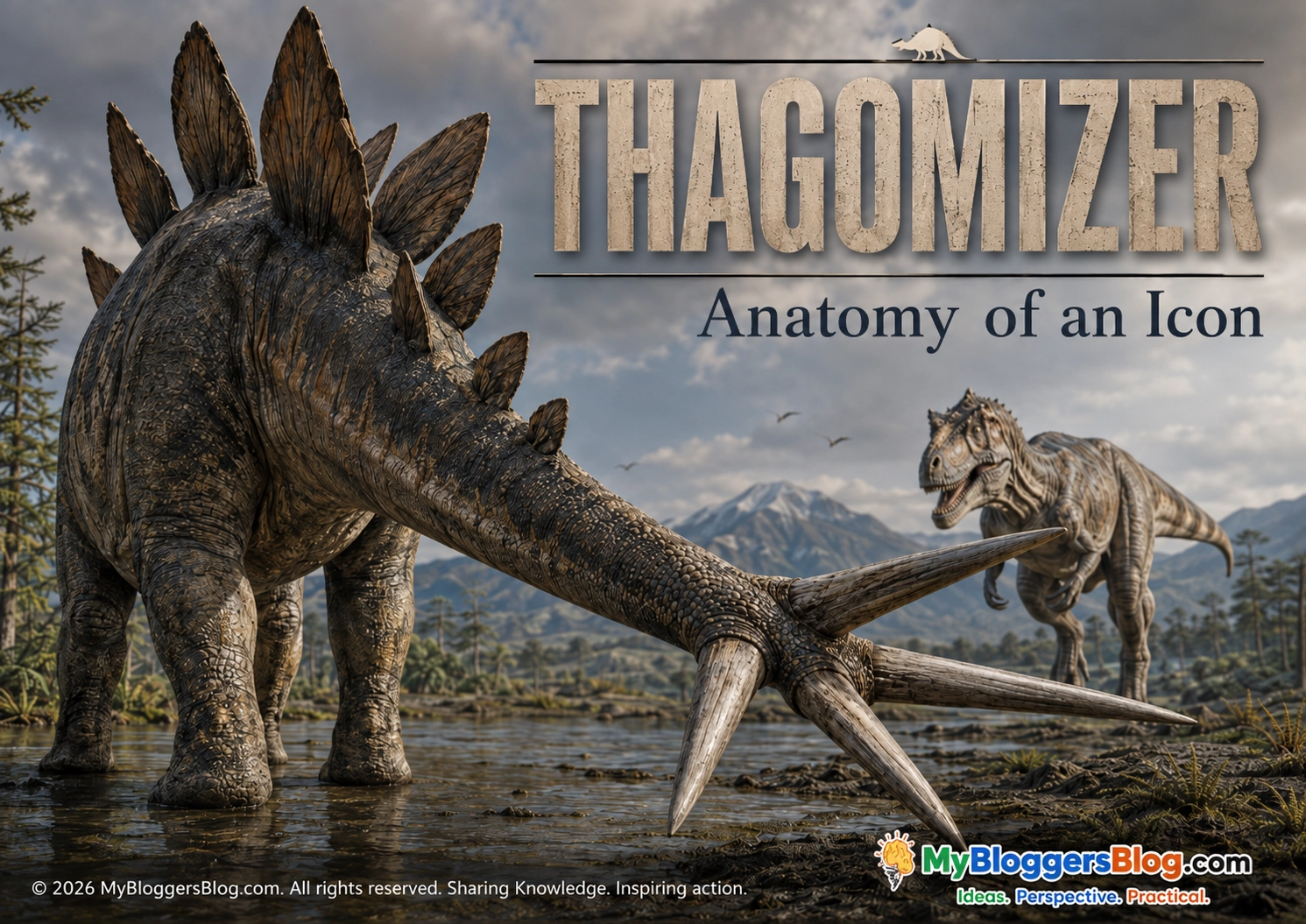
What exactly is a thagomizer?
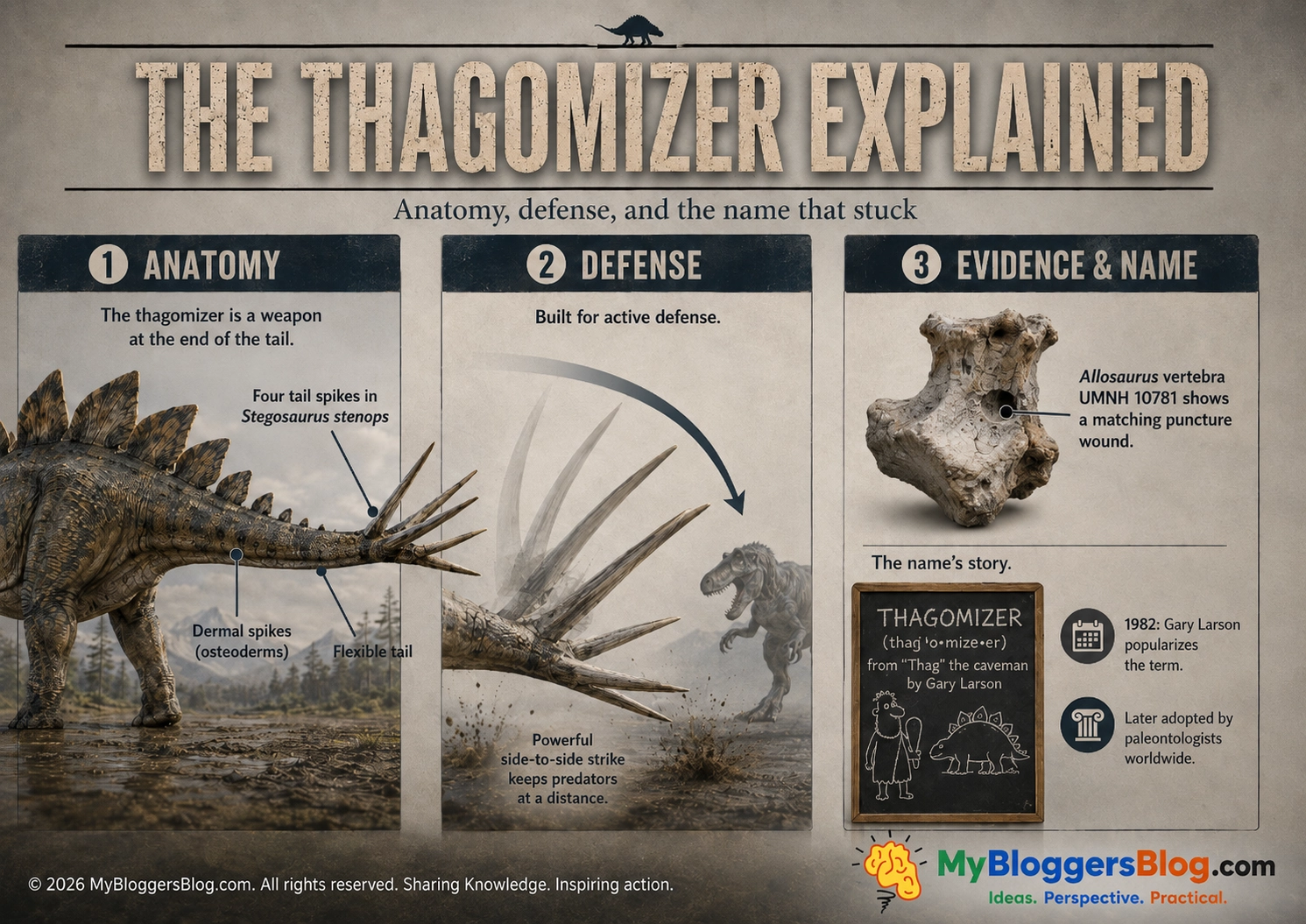
A thagomizer is the familiar cluster of pointed bony spikes at the end of a stegosaurian tail. In the best-known species, Stegosaurus stenops, the complete tail weapon consisted of four terminal spikes, arranged as two pairs. These spikes were dermal bones, or osteoderms, rather than elongated vertebrae.
The distinction matters because popular reconstructions sometimes treat the tail spikes as if they were simply sharp extensions of the skeleton. They were specialized elements of the skin and connective tissues, part of the same broad armor system that produced the animal's famous back plates.
There is also an important language correction. “Thagomizer” is an extremely successful nickname, not a formally established anatomical term. The American Museum of Natural History explicitly notes that scientists can simply call them tail spikes. The playful term survives because it is memorable, useful, and instantly understood.
The Late Jurassic animal behind the weapon
Stegosaurus lived in western North America during the Late Jurassic. The U.S. National Park Service dates deposition of the Morrison Formation, the rock unit that preserves many classic North American dinosaurs, to approximately 157 to 150 million years ago. Those landscapes contained rivers, floodplains, lakes, conifers, cycads, ferns and horsetails, along with giant sauropods and large predatory theropods.
The predator most closely connected with the thagomizer story is Allosaurus. Both genera occur in the Morrison Formation, so an encounter between them is not an artistic invention created merely because the silhouettes look dramatic together. They actually belonged to the same broad ecosystem.
A large herbivore did not need to outrun every predator if it could make the last few meters of an attack dangerously expensive. That is where the tail weapon becomes evolutionarily important. A predator approaching the hindquarters faced not an inert tail, but a muscular appendage ending in sharp, reinforced spikes.
Anatomy: four spikes, living tissue, and a powerful tail
An exceptionally complete Stegosaurus stenops skeleton described in the scientific literature preserves eighteen plates and four terminal spines in their anatomical sequence. That kind of articulated specimen is crucial because isolated osteoderms can be difficult to place correctly on the body.
The spikes were living bone during the dinosaur's life. Histological research on Stegosaurus plates and spikes found vascular grooves, foramina and tissue structures consistent with a covering of living soft tissue. Those features have been interpreted as evidence that the osteoderms were probably covered by a keratinous sheath, somewhat analogous in material, though not necessarily in shape, to horn or claw coverings in living animals.
That point should be stated carefully. The fossil evidence supports a keratin covering; it does not let us confidently calculate how many centimeters the sheath added to each spike or exactly how much sharper it made the weapon. Claims that the sheath dramatically increased reach or penetration go beyond what is directly preserved.
The tail itself was not simply a loose whip. Its vertebrae, musculature, plates and connective tissues created a complex mechanical system. Research cited in stegosaur biomechanics indicates that some regions had substantial lateral mobility, while the large tail plates in Stegosaurus could also restrict motion and create more rigid segments. The useful picture is therefore a powerful, controlled, laterally mobile defensive tail, not an infinitely flexible lash.
Was it really a weapon?
For any extinct animal, function has to be reconstructed from anatomy, wear, injury, comparison and mechanical feasibility. A spike can look dangerous without proving that it was used in combat. The thagomizer is compelling because several independent lines of evidence point in the same direction.
One line comes from the spikes themselves. Studies of stegosaur tail spikes from the Morrison Formation found that roughly 10 percent of a sample of 51 spikes had broken tips with bone remodeling. Remodeling means the damage happened while the animal was alive and that it survived long enough for healing to begin.
A broken spike could result from more than one kind of collision, so this is not a videotape of combat. But repeated healed trauma on a structure already positioned to strike an attacker is difficult to dismiss as a purely decorative feature. Some damaged spikes also show pathology consistent with infection following trauma, reinforcing the conclusion that these were serious injuries sustained during life.
The National Park Service now describes the massive tail spikes of Stegosaurus as having been used in defense against predators. The American Museum of Natural History likewise presents defense as the probable role of the four terminal spikes.
The Allosaurus wound: fossil evidence of a strike
The most famous evidence is an injured Allosaurus caudal vertebra, specimen UMNH 10781. Kenneth Carpenter and colleagues described damage to the vertebra that is congruent with the kind of wound a Stegosaurus tail spike could produce.
The injury affected a projecting part of the vertebra. The geometry of the missing bone and the associated remodeling are consistent with a puncturing strike, and the bone shows that the animal survived the event for at least some period afterward. Later biomechanical literature continues to cite the specimen as evidence of a high-energy stegosaur tail-spike impact.
It is tempting to phrase the fossil as an absolutely proven moment in which one identifiable Stegosaurus stabbed one identifiable Allosaurus. Paleontology rarely offers that level of certainty. The stronger and more defensible formulation is that the wound is highly consistent with a Stegosaurus tail-spike strike, and that it fits the broader anatomical and pathological evidence for active defense.
That nuance makes the case stronger, not weaker. The argument does not depend on a single spectacular fossil. It depends on the convergence of the fossil wound, healed spike damage, anatomy, predator-prey coexistence and mechanical modeling.
Biomechanics: how dangerous could the tail be?
Computer modeling has helped test whether a stegosaur tail could move quickly enough to cause meaningful injury. One of the most detailed studies modeled the tail of Kentrosaurus aethiopicus, a different stegosaur from Africa. That distinction is essential: exact speeds calculated for Kentrosaurus should not be copied directly onto Stegosaurus.
In Heinrich Mallison's 2011 biomechanical analysis, modeled continuous tail swings produced tip speeds ranging into the double digits in meters per second, while modeled whiplash motions could exceed 25 meters per second under some assumptions. The study concluded that the tail was capable of slashing injuries and penetrating trauma. Some modeled impacts had enough energy to fracture ribs or facial bones, and the most energetic aimed blows could potentially fracture stronger long bones.
This does not mean every tail swing was a bone-shattering strike. Impact depended on muscular force, range of motion, spike orientation, the location of the target and whether contact was penetrating, slashing or blunt. A spike traveling at the wrong angle might scrape or club rather than stab.
The most useful conclusion is therefore qualitative rather than theatrical: a stegosaur tail was mechanically capable of being a dangerous active weapon. That conclusion matches the injuries preserved in the fossil record.
What the evidence does not prove
The thagomizer has become so iconic that reasonable conclusions are sometimes inflated into certainty. Several limits are worth preserving.
- We cannot assign an exact strike speed to a living Stegosaurus. Published speed models depend on reconstructed muscles, motion ranges and assumptions, and detailed numerical work has often involved other stegosaur genera.
- We cannot measure the original keratin sheath directly in most fossils. Bone surface anatomy supports a keratin covering, but its full living dimensions remain uncertain.
- Not every damaged tail spike must record a predator encounter. Intraspecific fighting, accidents and environmental collisions are possible alternative causes for individual injuries.
- The Allosaurus wound is strong evidence, not a time-stamped crime scene. Its morphology is highly compatible with a stegosaur spike impact, but fossil behavior is reconstructed probabilistically.
- “Thagomizer” is informal terminology. Its cultural success should not be confused with formal taxonomic or anatomical naming procedure.
Scientific reconstruction is strongest when it states both what the evidence supports and where the evidence stops.
How a Far Side joke supplied the name
The biology is Jurassic. The word is modern.
Gary Larson published the The Far Side cartoon titled “Thagomizer” on May 27, 1982. The panel shows a caveman lecturer pointing to the spiked end of a stegosaur tail and explaining that the structure was named after “the late Thag Simmons.” The joke only works because the audience immediately understands the implied cause of Thag's lateness.
The cartoon was scientifically anachronistic, of course. Humans and stegosaurs were separated by an enormous span of geological time. That was part of the absurdity, not a claim about prehistory.
The term then escaped the cartoon. Paleontologists and museum educators later adopted the term informally. Over time it became common enough that major museums now use and explain it for the public.
That does not make the word formally sanctioned anatomical nomenclature. In fact, the American Museum of Natural History makes the distinction explicit. Yet the term has achieved something rare: it is a joke-derived word that scientists, museum educators and dinosaur enthusiasts can use and understand without ambiguity.
Why the thagomizer matters
The thagomizer is interesting because it links several kinds of evidence that are often studied separately. Bone anatomy tells us what the structure was. Histology tells us that it was living, vascularized tissue and probably supported a keratin covering. Paleopathology records injuries suffered during life. Predator fossils preserve possible evidence of receiving the weapon. Biomechanical models test whether the required movements and forces were physically plausible.
Then culture adds one more layer. A cartoonist gave an unnamed anatomical structure a memorable label, and paleontologists found the label too useful to ignore.
The result is not quite the story that the original draft sometimes suggests. The thagomizer was not a formally christened scientific structure suddenly accepted into taxonomy, nor can every mechanical estimate be transferred directly from one stegosaur to another. But the corrected story is better: a real defensive specialization, supported by multiple independent lines of evidence, acquired an unofficial name so effective that science kept it.
Some dinosaur features are famous because they look extraordinary. The thagomizer is famous because we can ask a harder question: did it actually work? The fossil record's answer is unusually persuasive.
Authoritative sources
This article was verified against museum, government, publisher and primary scientific sources.
- American Museum of Natural History. “Apex Stegosaurus Fossil” and “11 Questions About Stegosaurus.” AMNH explains that Stegosaurus had four tail spikes, that “thagomizer” is not the formal scientific name, and that the spikes were probably defensive. AMNH.
- U.S. National Park Service. “The Morrison Formation.” NPS dates Morrison deposition to approximately 157–150 million years ago and describes the Late Jurassic ecosystem containing Stegosaurus and Allosaurus. NPS.
- U.S. National Park Service, Dinosaur National Monument. “Stegosaurus ungulatus.” NPS describes the massive tail spikes as defensive structures. Dinosaur National Monument.
- Maidment, S.C.R. et al. (2015). “The Postcranial Skeleton of an Exceptionally Complete Individual of the Plated Dinosaur Stegosaurus stenops.” PLOS ONE. The specimen preserves four terminal spines and documents the armor sequence. Article.
- Hayashi, S. et al. (2012). “Ontogenetic histology of Stegosaurus plates and spikes.” Palaeontology 55:145–161. Surface and histological features support the inference of a keratinous covering. Wiley.
- Mallison, H. (2011). “Defense capabilities of Kentrosaurus aethiopicus Hennig, 1915.” Palaeontologia Electronica 14(2), 10A. Computer modeling evaluates tail motion, impact geometry and injury potential. Palaeontologia Electronica.
- Carpenter, K., Sanders, F., McWhinney, L.A. & Wood, L. (2005). “Evidence for Predator-Prey Relationships: Examples for Allosaurus and Stegosaurus,” in The Carnivorous Dinosaurs, Indiana University Press. The chapter describes healed spike injuries and the pathological Allosaurus caudal. Indiana University Press.
- Natural History Museum of Utah. “Dreaming of Stegosaur Mysteries with Dr. Susannah Maidment.” NHMU discusses stegosaur defense and the tail-spike structure commonly called a thagomizer. NHMU.
- The Far Side / Gary Larson. Official archive listing for “Thagomizer,” published May 27, 1982. The Far Side official site.